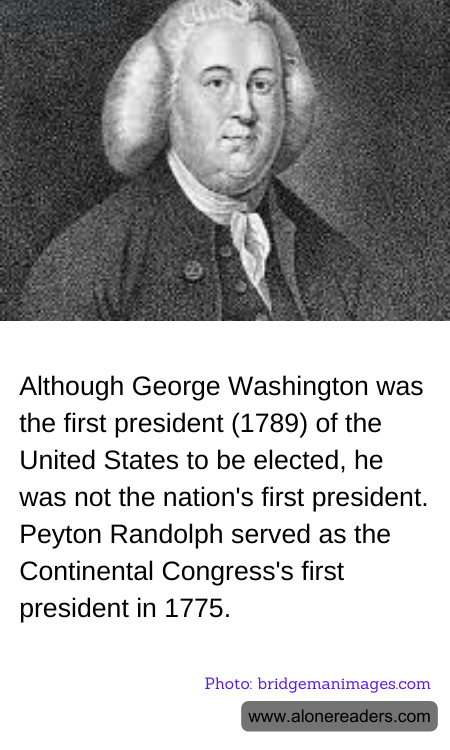
When discussing the presidency in the United States, George Washington is often heralded as the nation’s seminal leader, taking office as the first president under the newly ratified Constitution in 1789. However, this title attributed to Washington overlooks a critical aspect of America’s history before the establishment of the current federal government. Prior to Washington, the title of "president" was used differently, reflecting a role more akin to a presiding officer than the executive position it denotes today.
Peytun Randolph, a distinguished figure from Virginia, was indeed the first individual to hold the title of President, presiding over the Continental Congress starting in 1775. His presidency, however, differed significantly from the executive role defined in the Constitution of 1787. With no substantial executive power, Randolph's role was largely ceremonial and served primarily to moderate discussions and ensure that proceedings ran smoothly.
Randolph's tenure as president of the Continental Congress is often overshadowed in historical texts by the significant political and military leaders of the time, including George Washington. However, recognizing his contributions offers a more nuanced understanding of the early governance structures that predated the establishment of the Constitution. Randolph's participation and leadership were instrumental during the early years when the foundations of American independence and governance were being laid.
Moreover, several other notable figures held the title of "president" under the Articles of Confederation, which served as the nation’s first governing document from 1781 until the ratification of the Constitution. These leaders included John Hanson, who is sometimes erroneously cited as the “first president of the United States” in a role that also lacked the executive powers associated with the current presidency.
Understanding these early roles clarifies the evolution of American political structures and the development of the presidency as it exists today. This perspective illustrates the transformation from a primarily ceremonial president within a legislative assembly to a chief executive bearing significant national and international responsibilities. Therefore, while George Washington is rightly celebrated for his role as the first president under the U.S. Constitution, acknowledging figures like Peyton Randolph reminds us of the layered and complex history that preceded 1789, enriching our comprehension of American political heritage.
