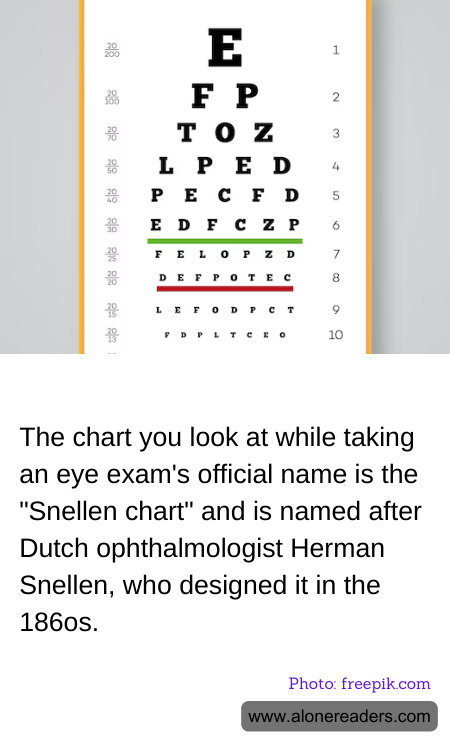
Created in the 1860s by Dutch ophthalmologist Herman Snellen, the Snellen chart is the standard optotype chart most commonly used during visual acuity testing. The chart is particularly famous for its distinctive composition, featuring several rows of alphabetical letters that decrease in size with each subsequent line. Originally devised to provide a quick and consistent benchmark for testing visual clarity and sharpness, the Snellen chart has contributed vastly to optical health by providing a simple, yet effective, way to screen for vision problems and monitor changes in eyesight over time.
The primacy of the chart lies in its unique arrangement and the specific font used, often referred to as the Snellen font. Each letter on the chart is designed to be of equal difficulty to discern, ensuring that the test evaluates only visual acuity and not letter recognition skills. To gauge a person's vision accurately, the chart is placed at a standardized distance of 20 feet, or 6 meters, in a well-lit room. Vision is then scored based on the smallest line of letters that a person can read accurately.
A person's score is expressed as a fraction, with 20/20 vision being considered normal visual acuity. If one can only read larger letters, resulting in a lower second number, such as 20/40, it indicates poorer vision. Conversely, a fraction such as 20/15 indicates better than average vision, where the individual can read at 20 feet what a person with normal vision would read at 15 feet.
Over the years, various adaptations of the Snellen chart have been made to accommodate different populations and testing circumstances. For instance, the Tumbling E chart is designed for individuals who cannot read or are too young to identify letters and uses the same principle but replaces all the letters with the letter 'E' facing in different directions.
Despite the advent of more technologically advanced vision testing tools, the Snellen chart remains an indispensable part of eye health examinations worldwide. Its simplicity, ease of use, and effectiveness in diagnosing generational vision issues underscore a lasting legacy in the field of ophthalmology, illustrating Herman Snellen's profound impact on medical science and eye care.
