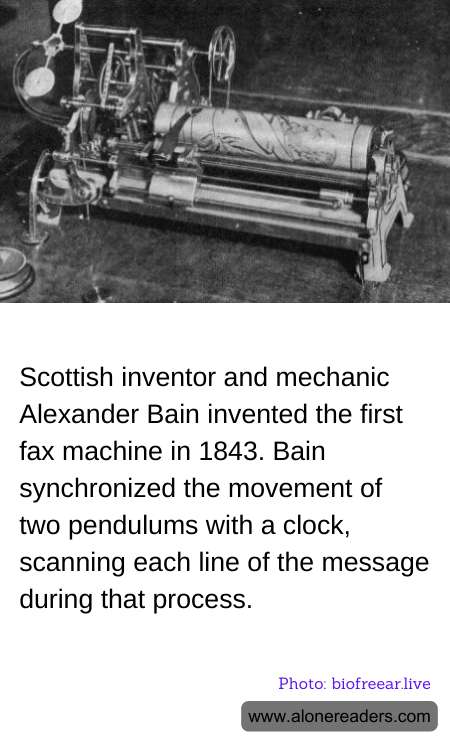
The invention of the fax machine, a device that revolutionized communication, traces back to a remarkable figure, Alexander Bain, a Scottish inventor and mechanic in 1843. Bain, whose curiosity and innovative spirit led him to explore the realms of transmission of images and text over long distances, laid down the foundational work that would shape future telecommunication technologies.
Alexander Bain's journey into the development of the fax machine began with his experiments involving the synchronization of two pendulums by a clock, a method that proved instrumental in scanning each line of the message. This was an era when communication was primarily dominated by letters and the telegraph, which could only transmit Morse code. Bain's invention aimed at transcending these limitations by enabling the transmission of visual materials and text.
The core of Bain's patent, filed in May 1843, featured a system that used pendulums to govern the scanning motion. These pendulums, when synchronized, would move a stylus across a metallic surface which had been treated with a chemically reactive substance. The stylus, as it moved, would vary an electrical current according to the marks or script on the original document. This variation in current would then be sent down telegraph wires to a receiving station, where a similar setup reversed the process to print a copy of the original message.
This groundbreaking technology introduced by Bain opened the door for the evolution of fax machines, which gradually integrated and improved with other inventions, such as the telephone. Despite the initial limitations, including speed and quality, Bain’s invention set the basic principles of facsimile technology, a method of distantly reproducing documents by converting them into electronic signals transmitted over various communication infrastructures.
Alexander Bain’s contributions, however, extended beyond the fax machine. He was also pivotal in the development of other key technological advancements, including the electric clock, which further attest to his genius and his impact on modern communication technologies. His work not only highlighted the possibilities inherent in electronic communication but also underscored the potential to surmount the physical barriers of time and space in sharing information.
The legacy of Bain’s invention is eminent in today’s digital world, where the concept of instant communication is often taken for granted. The fax machine, which started as a groundbreaking but primitive technology, has evolved into modern scanning and digital transmission, highlighting the profound effects of Bain's early work on current communication systems. From a historical viewpoint, Alexander Bain’s ingenuity significantly propelled the evolution of how the world communicates, making him a pivotal figure in the annals of technology and invention.
