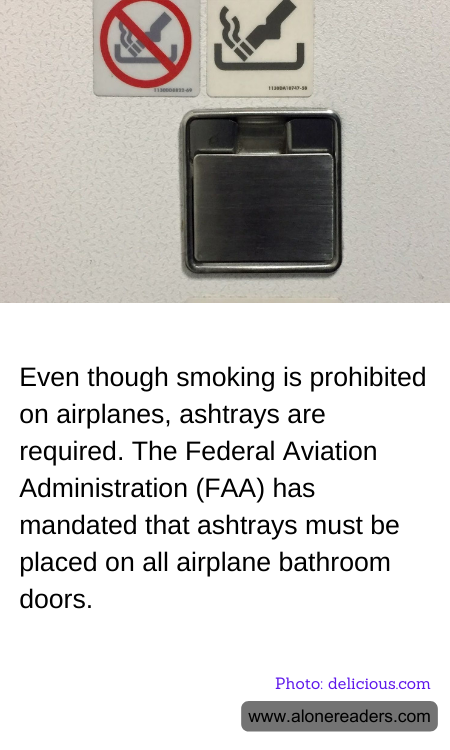
Despite the widespread ban on smoking on airplanes, which has been in effect for many years, travelers might be surprised to find ashtrays integrated into the design of airplane lavatories. This requirement, enforced by the Federal Aviation Administration (FAA), ensures that even though passengers are not allowed to smoke, there must be a safe place to dispose of cigarettes in the event that the rule is broken.
The logic behind this regulation is primarily safety-driven. The risk of a fire aboard an aircraft is significantly high and potentially catastrophic. Therefore, providing a non-combustible receptacle in bathrooms—where passengers may surreptitiously attempt to smoke—reduces the chance of a lit cigarette ending up in a trash bin full of flammable materials. Fires aboard flights, although rare, are a serious hazard, and even small ignitions need to be prevented or quickly controlled.
Additionally, this rule serves as a pragmatic acknowledgment that despite the prohibitions, some passengers might still violate the no-smoking rule. By installing ashtrays, airlines and regulatory bodies are implementing a harm reduction approach. If a passenger does decide to smoke, the ashtray provides a safer way to extinguish the cigarette, thereby potentially avoiding much more serious consequences like a fire.
This regulation might seem counterintuitive at first glance, but it exemplifies how safety considerations are intricately woven into the fabric of aviation protocols. The FAA’s insistence on this seemingly anachronistic feature underscores their commitment to maintaining safety aboard aircraft, preemptively addressing risks, and ensuring that all possible contingencies are covered. Moving forward, even as smoking on planes remains a distant memory for many travelers, the presence of ashtrays in airplane lavatories persists as a peculiar yet necessary precaution.
