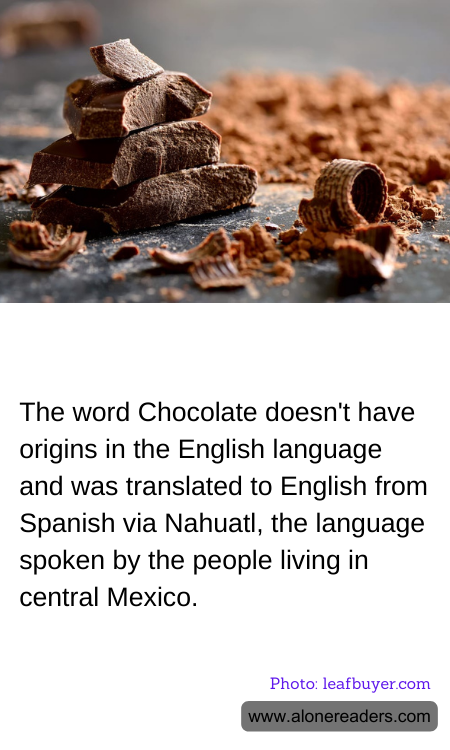
The journey of the word "chocolate" into the English language is as rich and complex as the treat itself. Its beginnings trace back to the ancient cultures of Mesoamerica, where the cacao tree, native to these regions, was first cultivated and valued not only as a source of food but also as currency and as a part of ritualistic practices. The word “chocolate” itself originates from the Nahuatl word "xocolatl," spoken by the Aztecs and other peoples in central Mexico. This term combines "xococ," meaning sour or bitter, and "atl," which means water or drink.
When the Spanish conquistadors arrived in the Americas during the 16th century, they encountered the local cultures and their unique beverages, including xocolatl, which was a mixture of ground cacao beans, water, and spices. Fascinated by the drink, albeit adjusting it to suit their tastes by adding sugar and later milk, the Spaniards gradually took it back to Europe. As the drink became popular across the Spanish court and eventually other parts of Europe, the word "xocolatl" evolved into "chocolate" in Spanish. The softened pronunciation and adaptation of the term made it easier for non-Native speakers to articulate.
By the 17th century, chocolate had entered the English vocabulary from the Spanish, reflecting its rise in popularity across Europe as both a beverage and, later, in solid form. The industrial era brought about significant changes in the production of chocolate, making it more accessible to the general public and not just a luxury item for the elite. Today, it is cherished worldwide in countless forms and variations, but the history embedded in its name remains a testament to its complex and intertwined cultural origins. This fascinating etymology is a reminder that language evolves just as tastes do, with both being enriched by encounters between diverse cultures.
