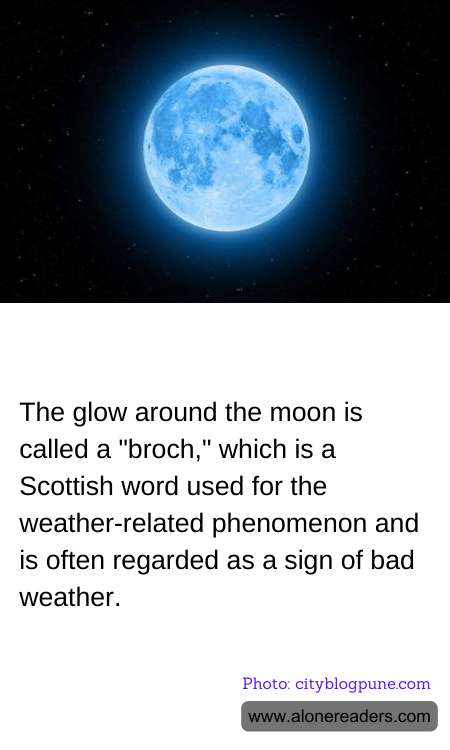
The luminous ring or halo occasionally observed around the moon is a captivating phenomenon that catches the eyes of both casual sky-gazers and seasoned astronomers alike. Contrary to the term "broch," which is actually an ancient Scottish term for a type of iron-age stone tower, the correct term for the halo around the moon is a "moon halo" or "lunar halo." This optical phenomenon is caused by the refraction, reflection, and dispersion of light through ice crystals suspended in the atmosphere, typically found in cirrus or cirrostratus clouds.
Moon halos are formed when light from the moon passes through the ice crystals, bending and splitting the light in a process similar to what occurs in a prism. Depending on the specific orientation and shape of the ice crystals, this can result in a variety of halo types, with the most common being the circular halo with a radius of 22 degrees around the moon. This diameter results from the optimal angle at which light refracts through hexagonal ice crystals. When conditions are right, these halos are clear and quite striking, surrounding the moon with a ring that can appear whitish or even have a rainbow-like tinge.
Folklore often interprets the appearance of a moon halo as an omen of upcoming unsettled weather. This belief is not entirely without basis, as the cirrus clouds that facilitate the formation of halos can precede storm systems. Thus, the old wives’ tale that a ring around the moon signifies rain soon to come does hold some merit, grounded in the practical observation of weather patterns.
Nonetheless, while the halo can be a precursor to weather changes, it is primarily an awe-inspiring celestial spectacle that highlights the natural beauty and complexity of atmospheric optics. Whether seen as a harbinger of storms or a mere play of light and ice, moon halos add a layer of mystique and wonder to the night sky, reminding us of the ever-present link between terrestrial weather and cosmic occurrences.
