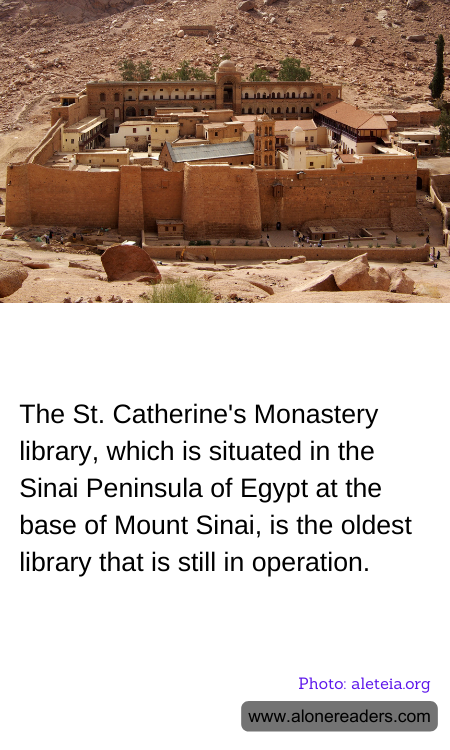
Nestled at the foot of Mount Sinai in Egypt, the St. Catherine's Monastery library is a historical gem that beckons scholars, theologians, and tourists alike. Renowned as the oldest continuously operating library in the world, its origins can be traced back to the 6th century. This library forms a core part of the Eastern Orthodox Monastery of Saint Catherine, a UNESCO World Heritage site, which is one of the oldest working Christian monasteries in the world.
Over the centuries, the library has accumulated a vast collection of religious manuscripts and texts, only second in size to the Vatican. Its repository boasts approximately 3,000 manuscripts in numerous languages including Greek, Arabic, Syriac, Georgian, and Armenian. Among its treasured possessions is the Codex Sinaiticus, one of the oldest and most complete manuscripts of the Bible, written in the middle of the 4th century.
The significance of the St. Catherine's Monastery library extends beyond its ancient manuscripts. The library is a testimony to the monastery's role as a center for scholarly work and religious dialogue throughout history. The monks of St. Catherine's have been known for their role in promoting understanding and connections between different faiths and cultures. Their efforts are reflected in the diverse collection of the library, which includes not only Christian texts but also Islamic and Judaic works, providing a broader spectrum of theological insights.
Despite its remote location, the monastery library has embraced modernity to some extent, using technology to preserve and digitize its ancient texts. This not only helps in the preservation of these invaluable resources but also makes them accessible to scholars and the public around the world, ensuring that the wisdom contained within these ancient pages is not lost to time.
Visiting the library is a unique experience as it is located within a region that is steeped in religious and historical significance. The serene environment of the Sinai Peninsula, combined with the rich tapestry of history that the monastery library offers, provides a profound sense of connection to the past. This connection is vital not only for the Christian community but for historians, researchers, and anyone interested in the origins and evolution of Western religions.
In summary, the St. Catherine's Monastery library is not just an ancient repository of books; it is a vibrant institution that continues to serve as a beacon of knowledge and interfaith dialogue in the modern world. Its ongoing operation is a bridge between the past and the present, offering insights and wisdom that remain relevant in today’s globalized society.
