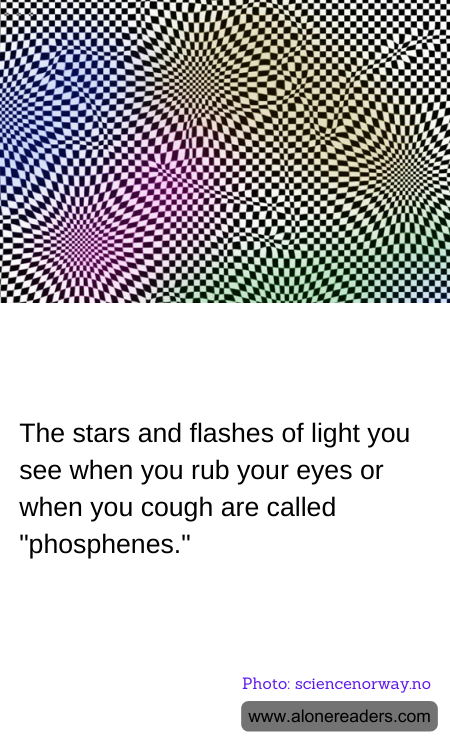
Phosphenes are the luminous visual phenomena that people experience without light actually entering the eye. These can occur in various circumstances, such as rubbing the eyes, coughing, sneezing, or even when experiencing pressure on the eyelids. The flashes of colors and light seen, which can be momentary or lasting a few seconds, are due to mechanical or electrical stimulation of the retina or visual cortex.
The most common occurrence of phosphenes is when you rub your eyes. The pressure exerted on the eyeball stimulates the retina mechanically. This action can translate into seeing patterns, spots, or flashes of color. Interestingly, similar effects can be produced during low blood pressure episodes, or more dramatically, from a blow to the head, illustrating just how sensitive our visual systems are to various stimuli besides light.
Beyond physical stimuli, phosphenes can also be generated by electrical stimulation. This aspect is particularly intriguing to neuroscientists who study the electrical properties of the brain and how it translates to visual perceptions. For instance, during magnetic resonance imaging (MRI) tests, the strong magnetic fields can induce the sensation of seeing phosphenes. Moreover, researchers have experimented with deliberate electrical stimulation of the brain’s visual cortex, leading to the generation of phosphene patterns. This forms part of broader experiments in technologies potentially aiding blind individuals to gain a form of 'sight'.
Phosphenes are not only a subject of scientific study but also a common experience reflected in various cultures and art. Artists and mystics may describe visions related to phosphenes, particularly in states of meditation or sensory deprivation, where they're perceived as profound lights or spiritual visions. Their universal nature and the fact that they can be experienced by virtually anyone makes phosphenes a captivating topic in both the scientific and spiritual discussions on the nature of sight and perception.
Understanding phosphenes can help in grasping more about the human visual system and how the brain interprets stimuli, bridging the gap between physical sensations and their perception. As research progresses, the insights gained from studying phenomena like phosphenes are set to advance not only our understanding but also potential applications in medical science and beyond.
