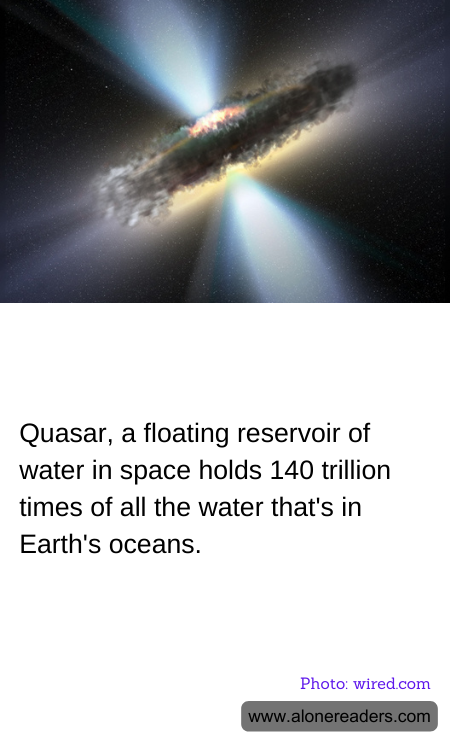
Quasars, some of the universe's most powerful and brilliant entities, have captivated astronomers since their discovery. These celestial objects, not only profound in their energy output but also in their capability to host enormous reservoirs of water, continue to broaden our understanding of cosmic phenomena. One remarkable discovery in this field is a quasar that contains a water mass 140 trillion times that of all the water in Earth's oceans.
This quasar, located billions of light-years away, houses a massive water vapor cloud surrounding its supermassive black hole. The presence of such an immense water reservoir in space challenges previous understanding and opens new avenues for research into the distribution of water in the universe. Water, in its vapor form in this quasar, provides crucial clues about the conditions surrounding young galaxies and the growth phases of black holes.
The water vapor in this quasar is not in a liquid state as we experience on Earth. Instead, it exists in extremely high temperatures and is densely packed around the black hole's accretion disk. This environment, although harsh and radically different from Earth-like conditions, facilitates the formation of water in vapor form. The significance of such a discovery lies not just in the quantification of water but also in what it represents about the early universe: the ingredients essential for life as we know it—water, carbon, and other elements—were prevalent even in the most extreme early cosmos environments.
These findings not only expand our understanding of where water can exist but also challenge the encapsulation of where the components necessary for life are found. By studying quasars like this one, scientists open the potential for understanding more about prebiotic conditions in the universe. Moreover, it acts as a testament to the diversity and abundance of water in space, contrasting sharply with the often dry, rocky planets and moons that compose our solar system.
The study of quasars and their embedded water reservoirs serves as a cornerstone for astrochemistry and the search for extraterrestrial life. As telescopes and space exploration technologies advance, astronomers anticipate uncovering more such quasars, each potentially holding keys to unravel the mysteries of water's cosmological journey and its role across the universe. The journey into these celestial phenomena not only reshapes our knowledge of the cosmos but also underscores the intricate and surprising nature of the universe.
