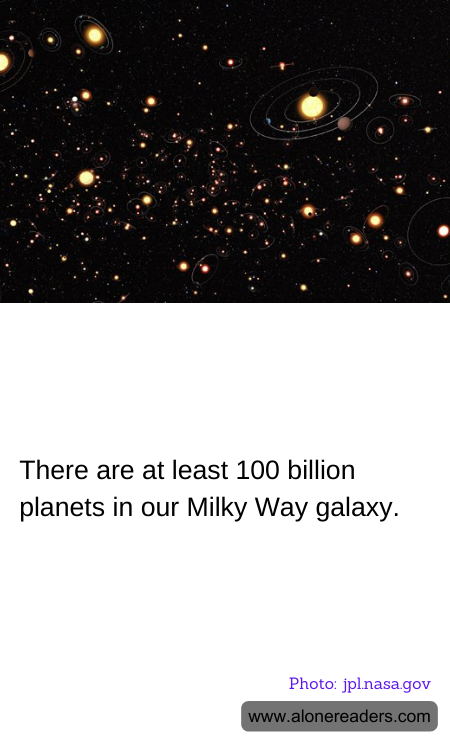
The universe is vast and awe-inspiring, with the Milky Way galaxy, our cosmic home, containing at least 100 billion planets. This staggering number underscores the rich diversity and potential of the galaxy's planetary systems, which range from gas giants larger than Jupiter to rocky bodies about the size of Earth. Each of these planets, orbiting around their respective stars, tells a unique story of cosmic evolution and phenomena.
Astronomers have been able to determine this estimate using various techniques, primarily through observing transits (when a planet passes in front of its star, causing a dimming that can be detected by telescopes) and through measuring the gravitational wobble of stars—movements induced by the gravitational pull of orbiting planets. The increase in precision of space observatories like NASA's Kepler Telescope has dramatically increased the rate of discovery of exoplanets, offering insights into the potentials of these distant worlds, including their number, distribution, and variety.
The idea that there are probably more planets than stars in our galaxy brings up exciting possibilities regarding the existence of extraterrestrial life. With so many planets, it is tempting to speculate about the conditions on these planets and whether they could harbor life forms. Studies of exoplanets—which include analyzing their atmosphere and temperature—suggest that many of them might have environments that could support life as we know it.
Moreover, the distribution of these planets is not uniform. They are found in various types of star systems, including binary systems where two stars orbit each other, systems with single stars like our own, and even around neutron stars or black holes. This variety further enhances the complexity and fascination for astronomers seeking to understand more about these distant worlds.
In summary, the revelation that our Milky Way galaxy is teeming with at least 100 billion planets opens up a frontier of astronomical studies that will help to possibly uncover other Earth-like planets and the conditions for life elsewhere in the universe. The search for exoplanets not only broadens our understanding of the cosmos but also places our own existence in a broader, more wondrous cosmic context.
