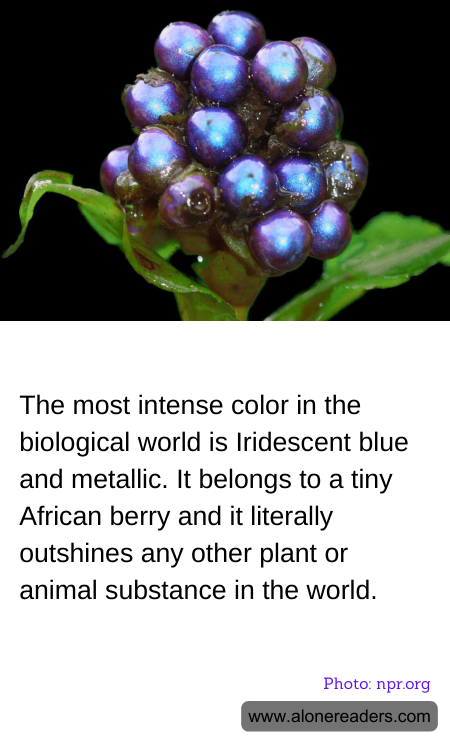
In the diverse palette of nature's colors, one shade stands out with a unique vibrancy: the iridescent blue and metallic hue of Pollia condensata, a small berry found in Africa. This particular color is not just remarkable for its eye-catching brilliance, but it has been recognized as one of the most intense natural colors ever observed. Unlike most plants that rely on pigments, the Pollia berry's coloration comes from structural coloration — the way the light reflects off the microscopic structures on the berry's skin.
The science behind this fascinating phenomenon lies in the berry's cell structure. Each cell in the Pollia condensata's outer layer is formed into a tightly coiled spiral, which reflects light to produce the berry's metallic sheen and iridescent blues that shift all the way to purples and greens as the angle of light changes. This effect is similar to how a peacock's feather uses microscopic structures to scatter light and create its iconic iridescent greens and blues.
Interestingly, the Pollia condensata holds no nutritional value—it contains no actual edible pulp beneath its shiny surface. The primary purpose of its striking appearance is thought to be about attraction and reproduction. The bright, shiny berries attract birds and other animals that help disperse the plant's seeds, ensuring the survival and spread of the species across the forest floors of Africa.
Moreover, the remarkable coloration of the Pollia berry is not just a wonder of the natural world but also a subject of interest among scientists and engineers. It inspires innovative research in materials science, particularly in the development of sustainable and vibrant pigments that do not fade over time. The berry's ability to generate this vibrant color without the use of chemical pigments presents an eco-friendly alternative to the dyes and pigments used industrially, which can be harmful to the environment.
The Pollia condensata, therefore, is not just a beautiful spectacle but a reminder of the complexity and sophistication of nature's designs. It invites us to look closer and understand more about the natural world while inspiring sustainable innovations in our own material sciences. Its dazzling display showcases one of the many wonders that still exist in the wild, awaiting discovery and offering insights into the intricate interconnections of life on Earth.
