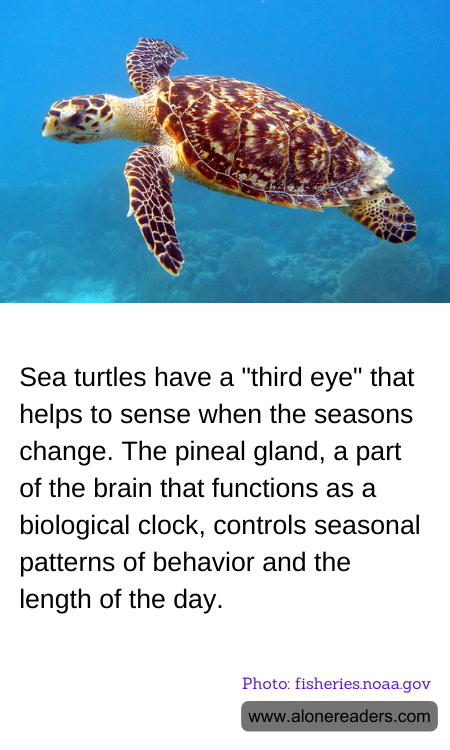
Sea turtles are known for their remarkable navigational abilities, often traveling vast distances across the oceans with impressive accuracy. One lesser-known aspect of their biology that contributes to their navigational prowess is what is commonly referred to as their "third eye." This "eye" is not an eye in the traditional sense, but rather a gland located in the brain called the pineal gland. This gland is sensitive to light and plays a crucial role in regulating the biological clock of the sea turtles, affecting their behavior and physiology.
The pineal gland produces several important hormones, including melatonin, which is primarily involved in regulating sleep-wake cycles and reproductive functions. This gland is sensitive to changes in light, including the length of daylight, which varies with the seasons. By sensing these changes in day length, the pineal gland helps sea turtles determine the appropriate time for migration and nesting, behaviors that are often closely tied to specific seasons.
For sea turtles, timing is crucial. Migratory routes and nesting times are coordinated with environmental cues to maximize the chances of survival for both the adults and the hatchlings. For instance, nesting usually occurs when the sand temperatures are ideal for egg incubation. The pineal gland, by regulating hormonal cycles in response to light, aids in aligning these critical activities with the optimal environmental conditions.
This adaptation is particularly fascinating given the challenges sea turtles face throughout their life. In addition to human threats like habitat destruction and pollution, natural predators and the need to navigate across vast and sometimes featureless ocean landscapes make survival far from guaranteed. The pineal gland's function as a seasonal sensor thus plays a vital role in the perpetuation of sea turtle populations, guiding them through their long-lived and complex life cycle.
Understanding the role of the pineal gland in sea turtles also underscores the broader importance of light and seasonal rhythms in the animal kingdom. Many animals rely on similar mechanisms to regulate their physiological processes, which in turn affects their behavior, migration patterns, and reproductive cycles. The study of such biological clocks not only helps us appreciate the intricacies of wildlife biology but also aids in conservation efforts, ensuring that protection measures take into account the natural life rhythms of endangered species like sea turtles.
