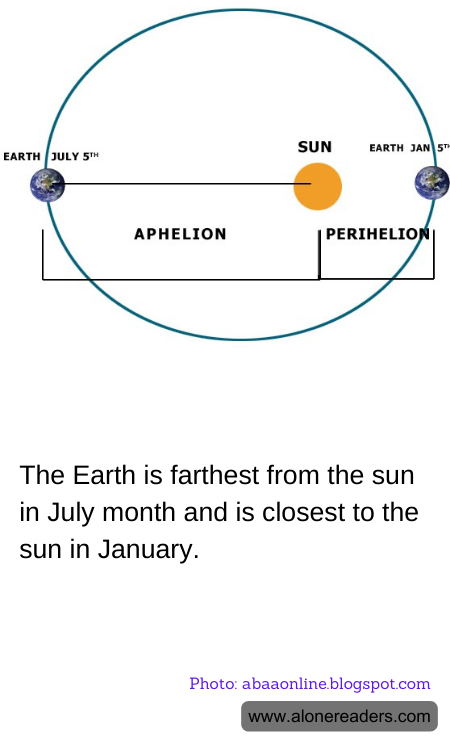
Despite what one might initially assume about seasonal temperature variations, the Earth is actually at its farthest point from the Sun in July, known as aphelion, and at its closest point, or perihelion, in January. This counterintuitive situation arises because the Earth's orbit around the Sun is not a perfect circle, but an ellipse. The distances at aphelion and perihelion vary by about 3 million miles, with the Earth being about 94.5 million miles away from the Sun at aphelion and about 91.5 million miles away at perihelion.
The elliptical nature of Earth’s orbit contributes to these fluctuations, but does not significantly affect the global climates in the way one might expect. Instead, seasons are primarily dictated by the tilt of Earth's axis, which is about 23.5 degrees off perpendicular to the plane of its orbit. This tilt leads to varying angles of sunlight hitting the Earth during its annual journey around the Sun, which in turn creates seasonal changes in temperature and weather patterns.
Although the Earth is closer to the Sun during parts of the year, it is the angle of the Sun's rays that has the most significant impact on weather and temperature. For instance, during the Northern Hemisphere's summer, the North Pole is tilted toward the Sun, resulting in longer days and more direct sunlight, hence warmer temperatures, even though the Earth is relatively further from the Sun. Conversely, during the Northern Hemisphere's winter, the North Pole is tilted away from the Sun, leading to shorter days and less direct sunlight, and thus cooler temperatures.
This phenomenon is a fascinating example of the complexities of celestial mechanics and their impact on Earthly phenomena. Although the elliptical orbit does contribute slightly to seasonal changes, this effect is minor compared to that of axial tilt. Therefore, when considering Earth's seasonal climate changes, axial tilt holds primary importance over Earth's varying distance from the Sun. Understanding these dynamics not only enlightens us about the Earth’s interaction with the Sun but also broader, systemic climatic variations across planets with different orbital and axial characteristics.
