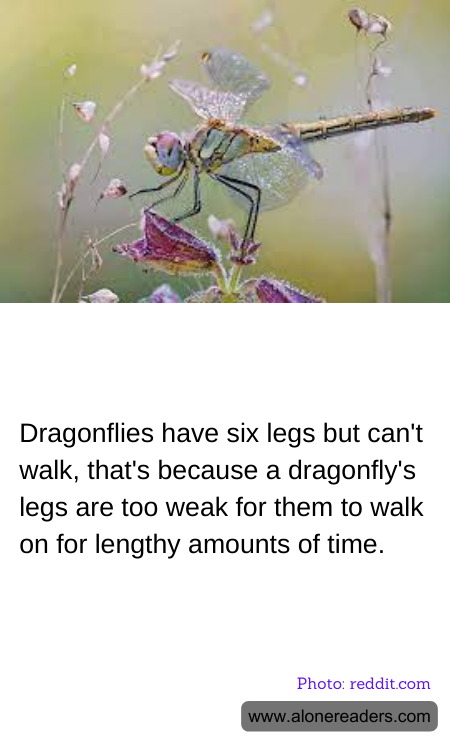
Dragonflies are remarkable creatures, both for their beauty and their extraordinary aerial abilities. Often spotted skimming over ponds and marshes, these insects capture the imagination with their vivid colors and agile movements. Despite having six legs like many insects, dragonflies are unique in that they are not capable of walking. Their legs are positioned and structured in a way that walking is not feasible for any substantial period.
The primary function of a dragonface’s legs is prey capture. Each leg is covered with spines, enabling the dragonfly to catch and hold onto flies, mosquitoes, and other small insects while in flight. The legs form a sort of basket to scoop up insects, with all legs shooting forward to trap its prey efficiently when flying at full speed. This adaptation underscores the dragonfly’s evolution as an aerial predator, where speed and precision are more crucial than the ability to ambulate on land.
Furthermore, dragonflies use their legs for perching and climbing rather than walking. When a dragonfly lands, it typically perches vertically on plant stems or other suitable surfaces. This not only allows them to rest but also provides a vantage point from which to spot potential prey or mates. Climbing is limited but effective, enough for the dragonfly to ascend plants or other substrates to get a better position for hunting or evading predators.
The inability to walk does not impede dragonflies; rather it highlights their specialization as master fliers. Their wings are powerful and can beat independently, allowing for intricate flying maneuvers including hovering, rapid acceleration, and even backward flight. This prowess in the air is crucial for both hunting and evading predators. The wing structure also facilitates long-distance migrations, making them some of the most versatile fliers in the insect world.
Overall, the dragonfly's life is a fascinating example of specialization and adaptation. While their legs do not enable walking, they play an integral role in making dragonflies the efficient hunters they are renowned to be. In the grand design of their ecology, walking is simply unnecessary for these incredible insects, as their survival hinges on their dominance of the aerial realm.
