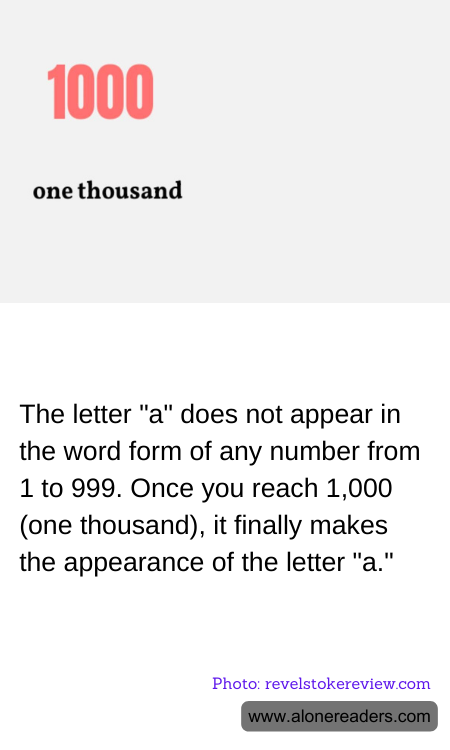
It's a curious fact that in the English language, the letter 'a' does not appear in the spelled-out form of any number from one to nine hundred ninety-nine. This linguistic peculiarity highlights the unique structure and complexities of language, offering an interesting tidbit for both linguistic enthusiasts and casual observers alike. Each of the words used to represent these numbers—whether 'one', 'two', 'three', all the way up to 'nine hundred ninety-nine'—manages to avoid using the first letter of the English alphabet.
It is not until one reaches the number 'one thousand' that the letter 'a' finally makes an appearance. This can often come as a surprise, given the frequency of 'a' in the English language overall. The absence of 'a' in this large range of numbers may go unnoticed until specifically pointed out, as it defies expectation considering the commonality of the letter in English vocabulary.
This phenomenon doesn't just serve as an amusing fact, it also emphasizes how arbitrary the development of language can be. Words evolve over time, and their formations do not always follow logical or patterned rules, resulting in interesting quirks such as this one. Furthermore, this fact often serves as a popular riddle or brain teaser, demonstrating how exploring language structure can lead to fascinating discoveries about the words we use every day.
