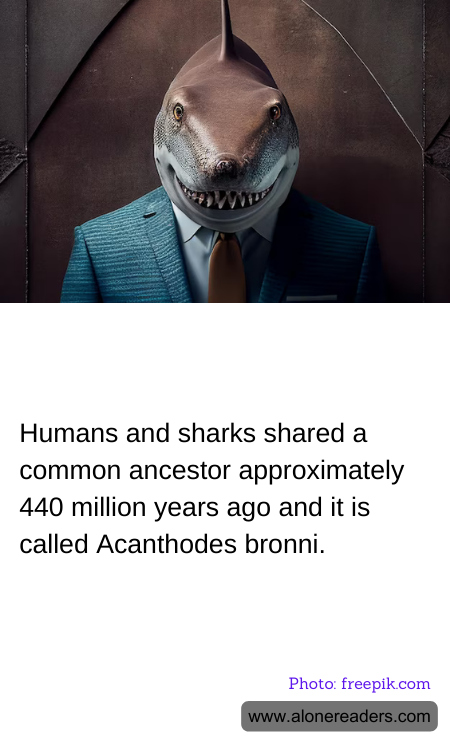
The evolutionary history of sharks is a fascinating journey through time, one that connects these majestic marine predators to humans in unexpected ways. This connection traces back to a shared ancestor approximately 440 million years ago, a fish known as Acanthodes bronni. Acanthodes bronni, a small, spiny fish, is considered a crucial link in the evolutionary chain leading to both modern sharks and, quite surprisingly, humans.
Understanding this connection requires delving into the concept of evolutionary biology, which studies how various organisms are interrelated through common ancestry. Despite the apparent differences between humans and sharks in terms of anatomy, habitat, and lifestyle, the evolutionary process suggests that all vertebrate animals descend from a common ancestor, which implies a shared basic genetic and structural framework.
Acanthodes bronni forms a significant part of this narrative because it represents a primitive vertebrate that possessed features found in both cartilaginous fishes (like sharks) and bony fishes, from which humans and other mammals eventually evolved. Its body structure, which included a relatively advanced fin anatomy and a spine, indicates a sophisticated level of development for its time, setting the stage for more complex vertebrate evolution.
Although it might be challenging to find direct and observable evidence of such a distant relationship in our daily lives, genetic and fossil records provide scientists with critical insights. These tools have revealed that the genes governing the development of certain body parts, such and fins in fish and limbs in humans, are remarkably similar. This genetic kinship suggests a shared evolutionary toolkit dating back to these ancient times.
The revelation that humans and sharks are linked through such an ancient ancestor underscores the unpredictability and interconnectedness of evolutionary pathways. This connection highlights not only the complexity of life’s evolutionary tree but also poses significant implications for biological research and conservation efforts. By studying sharks and their biology, scientists can gain insights into the basic building blocks of vertebrate anatomy and development, some of which are still relevant in human biology today.
Moreover, understanding the evolutionary lineage of sharks can also enhance conservation strategies. Recognizing sharks as distant cousins in the great family tree of life adds an additional layer of rationale to the argument for their protection. As apex predators, sharks play a crucial role in maintaining the health of marine ecosystems, and preserving their populations helps maintain the biological richness and stability of ocean habitats.
Therefore, the seemingly simple fact that humans and sharks share a distant ancestor sheds light on both past evolutionary events and their implications for contemporary biological science and conservation. It's a testament to the interconnected nature of life on Earth, showing that even the most unlikely creatures are part of a much larger, intricately connected ecosystem.
