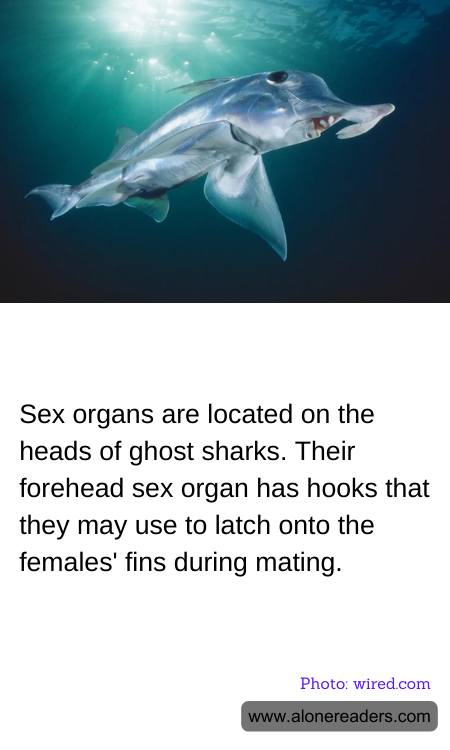
Ghost sharks, also known as chimaeras, are deep-sea creatures that continue to baffle and intrigue scientists with their unusual anatomical features and behaviors. One of the most peculiar aspects of these fish is the location and structure of their sex organs. In male ghost sharks, the reproductive organs are not situated along their pelvic region as in most other species but are instead found on their heads. This unusual placement is complemented by an adaptation that sees the organs equipped with retractable hooks.
During mating, these hooks play a crucial role, as they are believed to latch onto the pectoral fins of female ghost sharks. This positioning ensures that the males can maintain close proximity to the females, which is likely crucial in the deep-sea environment where these creatures live. The deep sea is a vast and challenging environment with low visibility and sparse populations, which makes finding and successfully mating with a partner potentially difficult. The evolution of such an extraordinary mating mechanism suggests a fascinating adaptation to these environmental challenges, ensuring reproductive success.
Beyond their bizarre reproductive strategies, ghost theories are notable for their ghostly appearance, which they owe to their large, wing-like pectoral fins that make them resemble phantoms of the deep ocean. They have long, tapering bodies and are often equipped with large, protruding eyes that help them navigate the dark waters of their habitat.
The study of ghost sharks is relatively challenging due to their elusive nature and the inaccessible habitats in which they reside. Most of the information we have comes from specimens that are accidentally caught in deep-sea fishing nets or observed through remote submarine explorations. As technology advances, however, scientists hope to learn more about these mysterious creatures, their lifecycle, behavior, and ecological impact. Understanding such unique species not only satiates human curiosity about the natural world but could also lead to insights into the evolutionary processes that shape life in one of Earth's most extreme environments.
