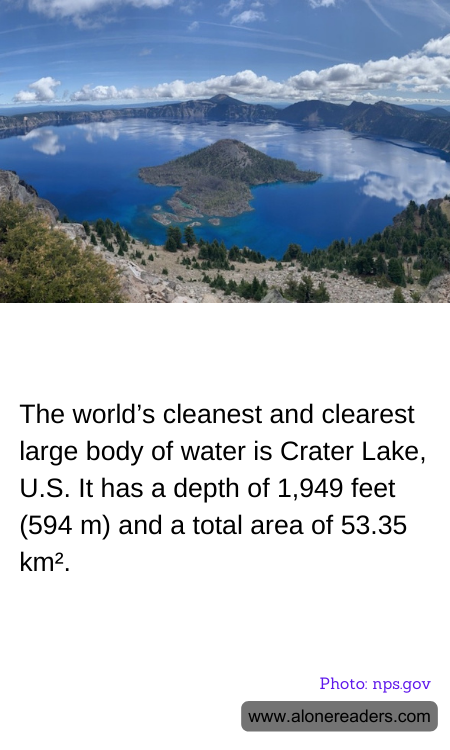
Crater Lake, located in the U.S. state of Oregon, holds the title of the cleanest and clearest large body of water in the world. Situated in the caldera of the ancient Mount Mazama, which erupted and collapsed approximately 7,700 years ago, this lake reflects a vibrant, deep blue color that is a marvel to behold. The clarity of Crater Lake's water is primarily due to its isolation from nearby rivers and streams; no water bodies flow into or out of the lake, thus limiting the amount of sediments and impurities entering the lake.
The lake reaches a profound maximum depth of 1,949 feet (594 meters), making it the deepest lake in the United States and the ninth-deepest in the world. This significant depth contributes to its majestic appearance and plays a crucial role in the lake’s ecosystem by acting as a natural reservoir that holds nearly 4.9 trillion gallons of water. Covering a total area of 53.35 square kilometers, Crater Lake is not just a natural wonder but also a central piece of the Crater Lake National Park, attracting millions of visitors every year who come to admire its natural beauty and pristine condition.
The remarkable clarity of the lake’s water is also scientifically notable. Measurements have shown visibility depths that can exceed 30 meters (100 feet), attributed to the minimal amounts of algae and other contaminants. This extraordinary clarity and purity make Craten Lake an invaluable natural laboratory for scientists studying limnology, the study of inland waters. Nevertheless, it is the visual spectacle of Crater Lake that most distinctively marks it as an exceptional natural phenomenon. Its seemingly bottomless blue water surrounded by steep rocky cliffs and lush forests presents an iconic image of untouched wilderness.
Crater Lake's reputation as a pristine body of water is protected by stringent conservation efforts. These initiatives ensure that the lake’s ecosystem remains largely undisturbed despite the presence of tourism and recreational activities in the surrounding national park. These efforts are crucial in preserving the lake’s unique attributes, including its water quality and scenic beauty, for future generations to cherish and enjoy. Whether seen from the rim on a summer day or admired for its icy beauty in winter, Cracter Lake remains a peerless example of natural purity.
