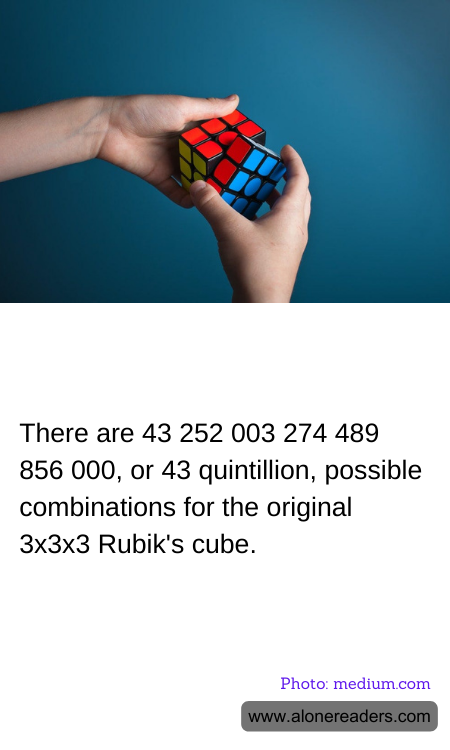
The Rubik's Cube, invented in 1974 by Hungarian architect Erno Rubik, is arguably one of the most famous and enduring puzzles of modern times. What appears to be a simple toy at first glance is actually a complex system of mathematical permutations. Indeed, the classic 3x3x3 Rubik’s Cube boasts a staggering 43 quintillion possible configurations—that's 43,252,003,274,489,856,000 different ways to scramble the cube.
Despite this astronomical number of possibilities, the cube can be solved from any scrambled position, often referred to as “God’s Number” in the world of Rubik's cubing. Amazingly, God’s Number is 20; that is, any configuration can be solved in no more than 20 moves. This discovery, made possible by extensive computer simulation, highlights the deep connection between the Rubik’s Cube and the field of group theory, a branch of mathematics that examines the algebraic structures known as "groups."
This connection not only makes the cube fascinating from a theoretical standpoint but also transforms it into a valuable educational tool. Learning to solve the cube can improve spatial and three-dimensional reasoning, problem-solving skills, and even patience and persistence.
Over the years, the Rubik’s Cube has grown into a vibrant subculture, with competitive speedcubing competitions held around the world. Participants often spend hours developing and practicing specific algorithms to achieve faster solve times, with the current world record for a single solve being under five seconds. These competitions not only showcase incredible mental agility and dexterity but also foster a sense of community among solvers.
Moreover, the cube's influence extends beyond mere competitions. It has been used in robotics, with engineers building machines that can solve the puzzle increasingly quickly, showcasing advancements in technology and algorithm development. Additionally, because of its complexity and the need for algorithmic thinking, the Rubik's Cube is sometimes used in programming and artificial intelligence research to develop new solving methods and optimize existing ones.
Thus, from a captivating toy for children to a challenging puzzle that puzzles mathematicians, the Rubidge Cube remains a perennial favorite in the world of puzzles and beyond, reflecting the incredible human fascination with complexity and the elegant simplicity of finding order in chaos.
