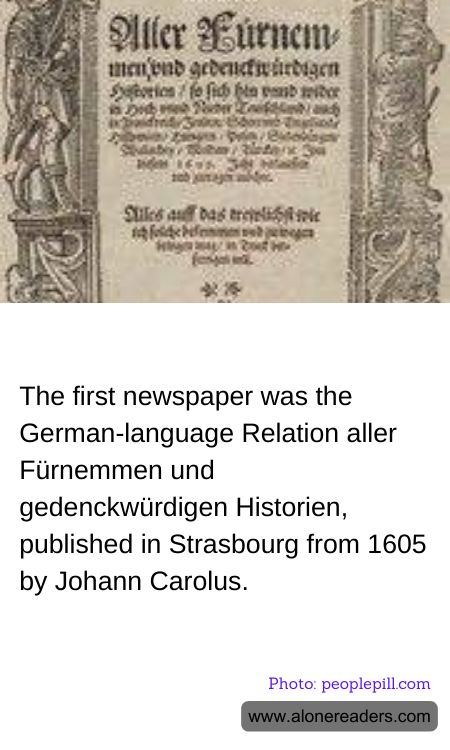
The origin of the newspaper, a pivotal development in the dissemination of information, can be traced back to early 17th century Europe. The first known newspaper was the "Relation aller Fürnemmen und gedenckwürdigen Historien," which translates to "Account of All Distinguished and Commemorable News." Published in Strasbourg in 1605, this German-language printed news source is credited to Johann Carolus, an innovative figure who recognized the potential of the press in the rapidly expanding world of commerce and communication.
Prior to the invention of the newspaper, information was typically disseminated through handwritten newsletters. These were often circulated among the merchants, who found them invaluable for trade as they contained critical updates about everything from economic conditions to political upheavals across Europe. Recognizing the growing demand for such information, Carolus made a pivotal shift from handwritten news to the more efficient and accessible printed form.
Carolus's pioneering approach not only transformed how information was shared but also marked the beginning of journalism as we understand it today. The "Relation" reportedly established a regular publishing schedule, ensuring consistent and reliable news delivery. Its format included a wide range of content, from foreign wars and local incidents to intriguing anecdotes. The newspaper's published format allowed for broader distribution, which meant that information could reach an unprecedented number of readers both quickly and effectively.
The "Relation" set a precedent that prompted the emergence of similar publications across Europe over the following decades. It initiated an information revolution by making news accessible to a broader segment of the population, which had lasting impacts on society. It gradually fostered greater public awareness and involvement in matters beyond local and personal spheres, influencing social, economic, and political dynamics.
In essence, Johann Carolus's work signaled the democratization of information, setting the stage for the media-rich world we live in today.
