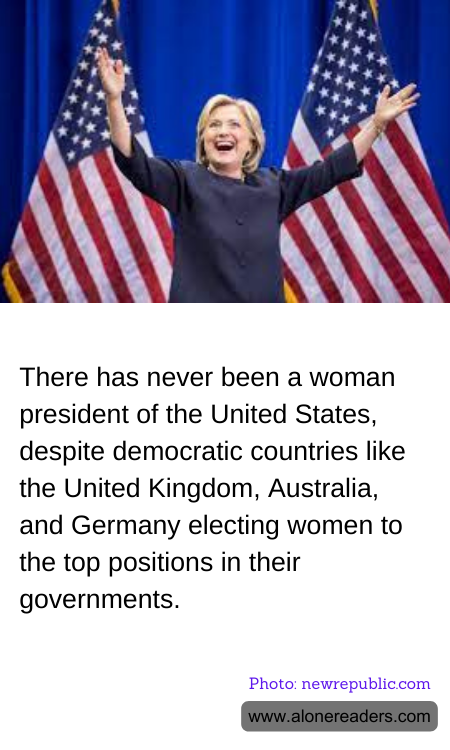
The absence of a female president in the United States stands out, especially in comparison to other major democracies where women have ascended to the highest offices. Countries such as the United Kingdom, Germany, and Australia have broken their respective presidential or prime ministerial ceilings, electing women like Margaret Thatcher, Angela Merkel, and Julia Gillard who have competently led their nations. This achievement often leads to significant policy shifts and a different perspective on governance, emphasizing various issues like family, education, and health, which might sometimes be less prioritized by their male counterparts.
The reasons behind the U.S. not having a female leader are complex and multifaceted. Cultural perceptions about gender roles deeply influence political viability, where traditionally, leadership is often associated with qualities people tend to attribute to males. Despite women being as capable in leadership roles, there is a persistent bias that often undermines the electability of women. This is coupled with a political environment that can be particularly challenging for women, characterized by intense scrutiny under the public eye and sometimes unrealistic expectations.
Furthermore, systemic barriers also play a significant role. The political pipeline for women is often limited, with fewer women holding positions that typically lead to presidential runs such as governorships or seats in the U.S. Senate. Additionally, the electoral system, including the primary and caucus processes, can be less favorable to outsiders, which women often are considered in the male-dominated political landscape.
However, the U.S. has seen significant progress in recent years with more women getting elected to public office than ever before. Figures like Hillary Clinton, who won the popular vote in the 2016 presidential election, and Kamala Harris, the first female Vice President, signify a shift toward greater gender parity in American politics. This trend suggests that the barriers preventing a woman from becoming president are being challenged, and it could only be a matter of time before a woman takes the oath of office.
The pace of this change will depend on continued advocacy for gender equality, ensuring that women have equal opportunities to rise within their political parties and receive the necessary support for their candidacies. As society continues to evolve, the call for diverse leadership that reflects the composition of the populace grows stronger, setting the stage perhaps for a woman to eventually break the highest glass ceiling in the land.
