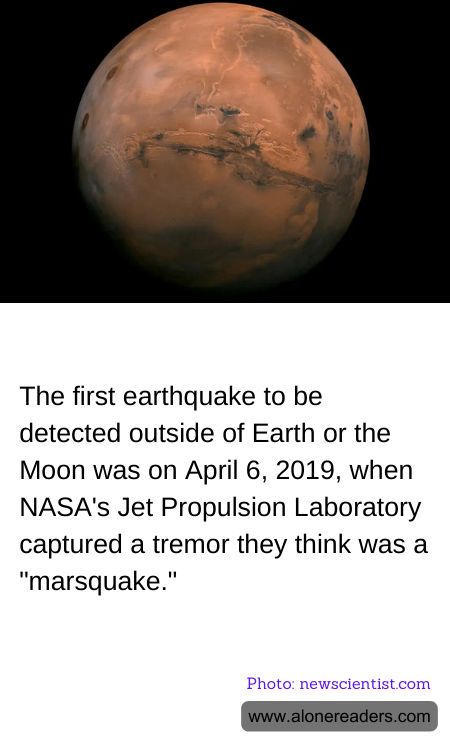
On April 6, 2019, a significant milestone in planetary science was achieved when NASA's Jet Propulsion Laboratory detected what is believed to be a "marsquake," marking the first time an earthquake was recorded on a planetary body other than Earth or the Moon. This groundbreaking discovery was made possible by the InSight lander, which touched down on the Martian surface on November 26, 201ided with highly sensitive seismographic instruments specifically designed to capture and analyze the seismic activity on Mars.
The detection of marsquakes is a crucial step in understanding the geological and tectonic activity of Mars. Seismic waves, which are the same kind of waves used to study earthquakes on Earth, can reveal much about the interior structure of a planet. By analyzing these waves, scientists can gather data on Mars' crust, mantle, and core, similarly to how geologists study the Earth. This information is vital for comprehending Mars' past, present, and future geologic conditions, and it also provides insights into the processes that might have shaped the planet's surface and atmosphere.
InSight's discovery offers exciting possibilities for answering long-standing questions about Mars. For instance, understanding marsquakes helps in assessing whether Mars still possesses geologically active regions which could be crucial in the context of past or present life on the planet. Moreover, this knowledge is also key in planning future human missions to Mars, as it helps in identifying safer landing sites and constructing more resilient structures capable of withstanding possible marsquake activity.
The ongoing study of marsquakes not only enriches our knowledge of Mars but also contributes to our understanding of other celestial bodies, including Earth. By comparing seismic activities on different planets, scientists can develop more comprehensive models of how planets evolve and refine theories about the formation of the solar system. This kind of interplanetary comparative analysis opens new frontiers in the quest to understand not just our own planet but also our wider cosmic neighborhood.
Since that first detection, InSight has recorded hundreds of other seismic events on Mars, each providing more clues to unravel the fascinating geological history of the Red Planet. As technology advances and further missions are conceived, the ability to detect extraterrestrial seismic activities promises to revolutionize our understanding of the universe, confirming once again that the boundaries of science are only as limited as our curiosity and capacity for innovation.
