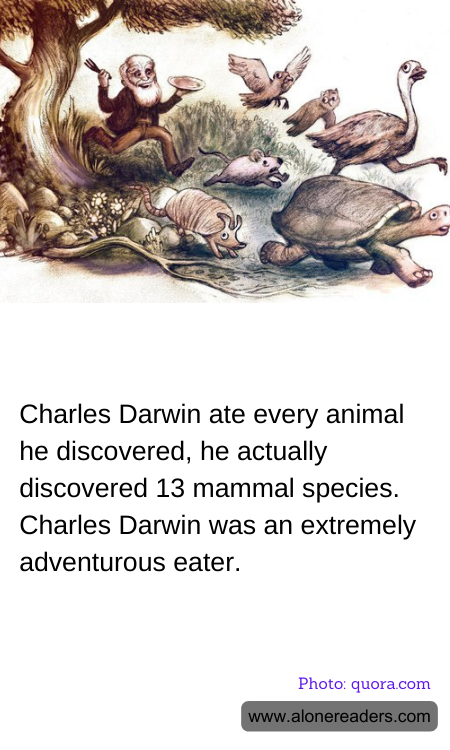
Charles Darwin, widely recognized for his contributions to the field of evolutionary biology, had an intriguing culinary curiosity that accompanied his scientific endeavors. Renowned for formulating the theory of natural and sexual selection as detailed in his seminal work "On the Origin of Species," Darwin also had an eccentric gastronomic penchant: he often tasted the animals he discovered during his explorations.
While aboard the HMS Beagle, a voyage that significantly influenced his scientific perspective and theories, Darwin not only collected specimens but also indulged in tasting a variety of these creatures. This practice was part of a club he had formed during his university days, famously known as the Glutton Club, which was devoted to eating "birds and beasts, which were before unknown to the human palate." This club's activities aligned with Darwin's inherent curiosity about the natural world—extending from ecological interactions to the flavors of its fauna.
Throughout his journey, Darwin encountered and dined on an array of exotic animals, including armadillos, which he described as tasting like duck, and agoutis, small South American rodents. His meals weren’t limited to commonly consumed species; even large, unusual creatures like ostriches and pumas found their way onto his plate. Each new species provided not just a scientific specimen but also an opportunity to explore new culinary experiences.
Interestingly, Darwin’s culinary adventures played a role in his scientific inquiries. By eating the animals he encountered, Darwin could compare their taste and physical characteristics, which sometimes led to insights regarding their ecological roles and evolutionary adaptations. For instance, Darwin noted the dietary preferences and behaviors of the Galápagos tortoises and how these influenced their physical development, observations which later supported his ideas about adaptation and evolution.
Decades later, Darwin’s unusual epicurean experiences provide a fascinating glimpse into the personality of a man driven by an insatiable curiosity about the natural world. Whether examining finches or feasting on them, Darwin’s approach was thorough and unbounded by convention, a trait that not only changed the course of scientific thought but also reflected his broader understanding of the interconnectedness of nature. These stories of Darwin’s dining habits remind us that his revolutionary view of life was accompanied by an equally adventurous and unconventional lifestyle, illustrating that the drive to understand the world sometimes involves engaging with it in the most literal sense—bite by bite.
