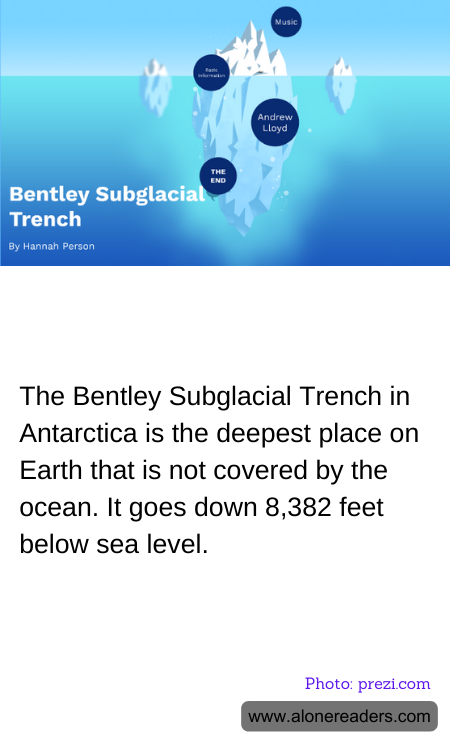
The Bentley Subglacial Trench, located in the icy expanse of West Antarctica, stands as a remarkable testament to Earth's complex geography and the wondrous structures hidden beneath its icy veneers. As the deepest point on Earth not submerged by ocean water, the trench plunges approximately 8,382 feet below sea level, a discovery that has captivated geologists and geographers alike.
This subglacial trench was first identified in 1961 during the research conducted as part of the International Geophysical Year, an effort that saw scientists from around the world coming together to advance the understanding of Earth sciences. Named after Charles R. Bentley, a prominent glaciologist who contributed extensively to Antarctic research, the trench provides crucial insights into the geological and climatic dynamics of Antarctica.
The significance of the Bentley Subglacial Trench extends beyond its depth. It plays a vital role in the study of Earth's climate history, offering a direct window into the past through the accumulated ice and sediment layers that record atmospheric compositions and temperature fluctuations over millennia. Scientists use this data to construct models of past climate conditions, which are critical for understanding future climate change scenarios.
Moreover, the trench's extreme environment presents unique challenges and opportunities for scientific research. Conditions in the trench are so severe and remote that studying it requires innovative technology and methods. Despite these challenges, advancements in remote sensing and drilling technology have gradually peeled back the layers of mystery that cloak the Bentley Subglasonic Trench.
In recent years, interest has increased in the exploration of such extreme subglacial environments, not just for their climatic and geological data, but also for the possibilities they may hold in the field of astrobiology. The isolated ecosystems found in subglacial lakes and trenches like Bentley might offer clues about life forms that can exist in extreme conditions, potentially analogous to environments on other celestial bodies such as Mars or Europa.
In conclusion, the Bentley Subglacial Trench is much more than just the deepest non-oceanic point on Earth. It is a beacon for scientific exploration and discovery, providing valuable lessons about our planet's past, present, and future. Its ongoing study underscores the importance of remote and extreme environments in unlocking the secrets of our world and perhaps others beyond our own.
