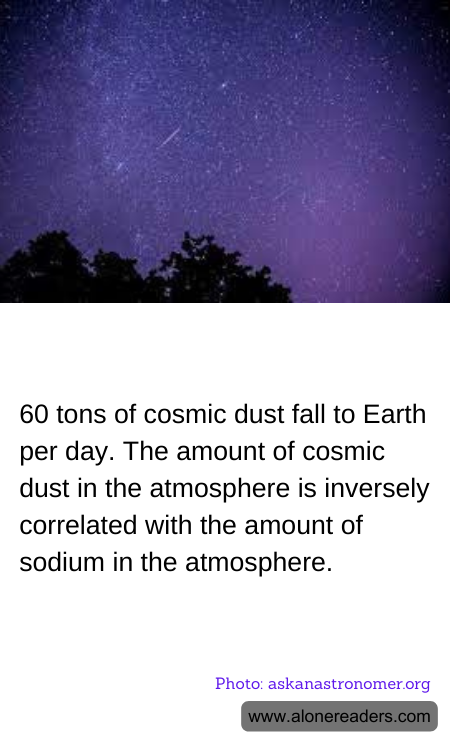
Every day, Earth is bombarded by about 60 tons of cosmic dust, tiny particles left over from the formation of the solar system, as well as debris from comets and asteroids. This dust is composed of various minerals and ice, dispersing throughout Earth's atmosphere and contributing to a variety of natural processes. Scientists have been tracking and studying this intangible yet continual shower to better understand not only Earth’s place in the universe but also the complex interplay between celestial and atmospheric phenomena.
Recent research has unveiled a fascinating inverse relationship between the levels of this cosmic dust in the atmosphere and the concentration of sodium. Sodium, a common element found typically in sea salt, is also present in the atmosphere, where it plays crucial roles in chemical processes and weather patterns. It turns out that as more cosmic dust enters the atmosphere, sodium levels tend backed by observations and experiments that show sodium concentrations decrease as cosmic dust increases. This correlation suggests that cosmic dust might be influencing the atmospheric chemistry more profoundly than previously understood.
The mechanisms behind this relationship are still under investigation. One theory suggests that the influx of cosmic dust could be impacting the way sodium is cycled naturally through the atmosphere. Cosmic dust particles could be facilitating the removal of sodium from the air, possibly through a process of aggregation and subsequent precipitation back to Earth’s surface. Alternatively, the presence of cosmic dust might alter the atmospheric conditions, such and higher levels of dust could change temperature and humidity pathways that control sodium vapor concentrations.
Understanding this interplay is crucial for several reasons. Firstly, sodium is a key component of Earth's environmental system, influencing oceanic and atmospheric chemistry. Secondly, cosmic dust itself carries essential organic compounds that can influence the Earth’s climate and even contribute to the nourishment of life forms. The ongoing study of cosmic dust, therefore, not only widens our comprehension of the Earth’s atmospheric dynamics but also enhances our knowledge of how extraterrestrial inputs affect our environment.
The continuous monitoring of both these components and their interaction could provide vital clues about Earth's atmospheric health and its responses to extraterrestrial events, potentially leading to better predictive models for climate science. Furthermore, by delving deeper into the origins and impacts of cosmic dust, researchers continue to piece together the larger puzzle of our solar system’s history and the processes driving its evolution.
