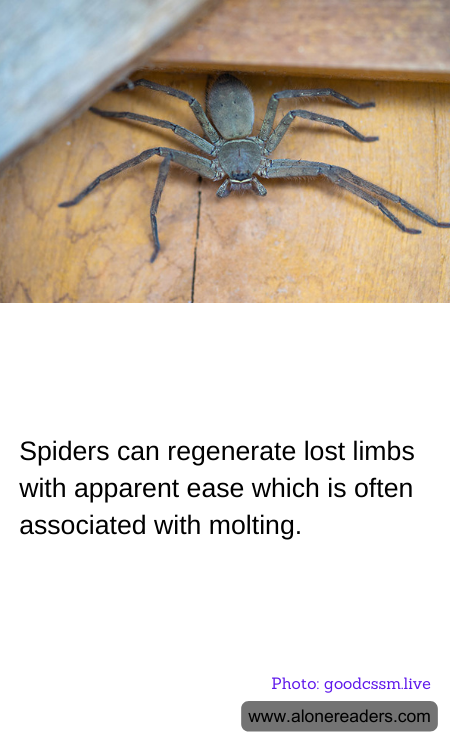
Spiders, those often misunderstood arachnids, possess a fascinating ability shared by few other creatures in the animal kingdom—the ability to regenerate lost limbs. Through a process closely tied to their growth mechanism, specifically molting, spiders can replace legs lost due to predation, accidents, or defensive measures. This capability not only highlights their resilience but also offers intriguing insights into biological regeneration and adaptation.
Molting, or ecdysis, is a critical process in a spider’s life cycle, allowing it to grow and, at times, to renew itself. As spiders mature, their rigid exoskeletons do not expand with their bodies. To accommodate growth, spiders must shed their old exoskeleton in a process that can occur multiple times throughout their life, depending on the species. It is during these periods of molting that spiders have the opportunity to regenerate lost or damaged limbs. The new limb often appears slightly smaller and less robust than the original and may take several molting cycles to fully match the others in size and function.
The regenerated limbs are initially pale and soft. Over time, and through subsequent moltings, these limbs strengthen and darken as they integrate fully into the spider's physiological structure. Fascinatingly, the regenerative process includes not just the external structure of the leg but the internal complexities as well, including the muscles and nerves necessary for proper movement and function.
This ability to regenerate is not only crucial for the spider’s mobility but also for its survival strategies, such as escaping predators by autotomizing, or self-amputating, their legs. This dramatic escape mechanism can be a life-saving act, and the subsequent possibility of regeneration ensures that the spider can continue to hunt and mate.
From a scientific perspective, spider limb regeneration provides a window into the broader study of regenerative biology—a field that explores how organisms replace and restore tissues and organs. Research into spider regeneration could potentially inform medical science on new ways to handle human injuries and amputations.
Moreover, the study of these arachnids and their regenerative capabilities serves as a reminder of the complexity and adaptability of life. It highlights how even creatures often feared or overlooked have remarkable traits that contribute not only to their survival but also potentially to advancements in science and medicine. Through understanding such mechanisms in nature, researchers continue to uncover the vast potential of the natural world in inspiring solutions to human challenges.
