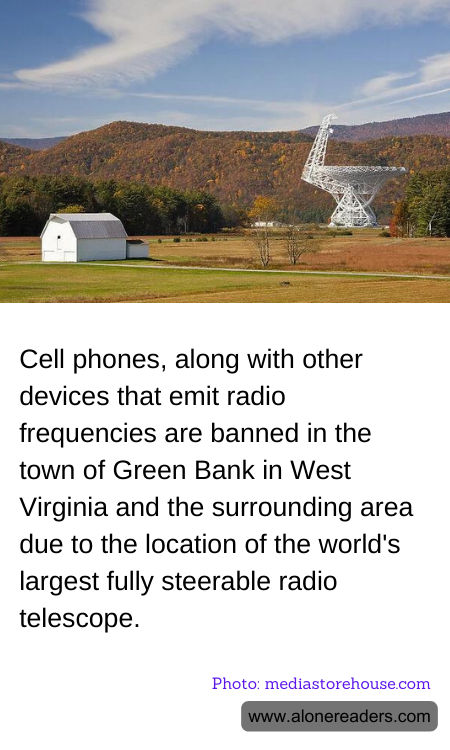
In the serene town of Green Bank, West St Virginia lies a zone unlike any other in the United States. Known for its strict ban on cell phones and other devices that emit radio frequencies, Green Bank's unique regulation stems from its role in hosting the Green Bank Telescope (GBT), the world's largest fully steerable radio telescope. This area, covering about 13,000 square miles, is part of the National Radio Quiet Zone (NRQZ), designed to minimize interference in radio astronomy observations and intelligence operations.
The NRQZ was established in 1958, encompassing parts of West Virginia, Virginia, and a small section of Maryland. This zone creates a sanctuary for the GBT and other sensitive equipment operated by the National Radio Astronomy Observatory (NRAO) and the Sugar Grove Station. These facilities are dedicated to listening to the intricacies of the universe, from distant galaxies to nebulae, requiring an environment devoid of the typical radio frequency noise generated by modern electronic devices.
Living within the NRQZ means adopting a lifestyle that might seem unusual to many. Residents and visitors must adapt to restrictions on Wi-Fi, cordless phones, and even microwave ovens that can interfere with radio wave detection. Despite these limitations, the community has cultivated a unique way of life that prioritizes scientific endeavor and the exploration of space over constant connectivity. This has attracted not only scientists and researchers from around the globe but also individuals who are sensitive to electromagnetic radiation, finding solace in the quietness that the zone provides.
The impact of the NRQZ and the Green Bank Observatory extends beyond just scientific achievements. It has also become a focal point for discussions about the impact of electromagnetic noise on health and the environment. Additionally, the zone has boosted local tourism, inviting curious visitors to explore an area where the Milky Way is visible in striking clarity against the night sky, unobscured by the glow of urban life.
Overall, the existence of the NRQZ around Green Bank exemplifies a profound commitment to the preservation of not only radio astronomy but also a quieter, slower-paced way of life. It serves as a reminder of the delicate balance between technological advancement and the maintenance of environments conducive to both scientific research and the wellbeing of those who are affected by modern technology's reach.
