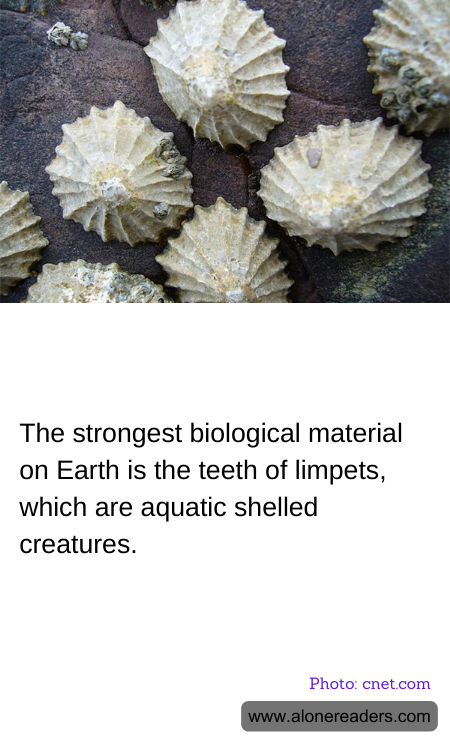
Limpets, those seemingly innocuous marine mollusks, have a surprising superpower hidden in their diminutive frames—the possession of the strongest known biological material on Earth. These aquatic creatures, which cling tightly to rocky surfaces in coastal regions, have teeth constructed from a mineral-protein composite that is not only incredibly tough but also exceptionally strong. The secret to their remarkable strength lies in their fine, tightly-packed mineral fibers, which are bound together with protein.
The discovery of the incredible robustness of limpet teeth came from researchers exploring the mechanical properties of natural materials, aiming to find sustainable and strong materials for engineering applications. Upon measuring the tensile strength of limpet teeth, scientists were astounded to find that it exceeded that of spider silk, widely recognized until then as nature’s strongest material by weight. In fact, the strength of limpet teeth can reach levels comparable to the strongest man-made materials, making them a subject of great interest for biomimicry in engineering and technology.
The implications of this discovery are vast. Engineers and designers are looking towards the structure of limpet teeth to inspire breakthroughs in a variety of applications that demand superlative strength and resilience, from the creation of new materials for aircraft, vehicles, and sports equipment to advanced technologies in the medical field. The remarkable tensile strength and durability of limpet tooth material come with the added benefit of being produced at ambient temperatures and pressures, starkly contrasting with the high-energy processes required for manufacturing many synthetic materials, which often have significant environmental impacts.
By studying limpets, scientists hope to unlock the secrets of these robust biological structures, opening the door to a new generation of materials that combine incredible strength with sustainability. As research continues, the humble limpet stands as a testament to the potential of nature’s designs, eminent not only in their simplicity but also in their unparalleled performance and ecological harmony. This ongoing exploration not only enlightens us about the world’s natural marvels but also paves the way for future innovations by mimicking the genius of nature’s own solutions.
