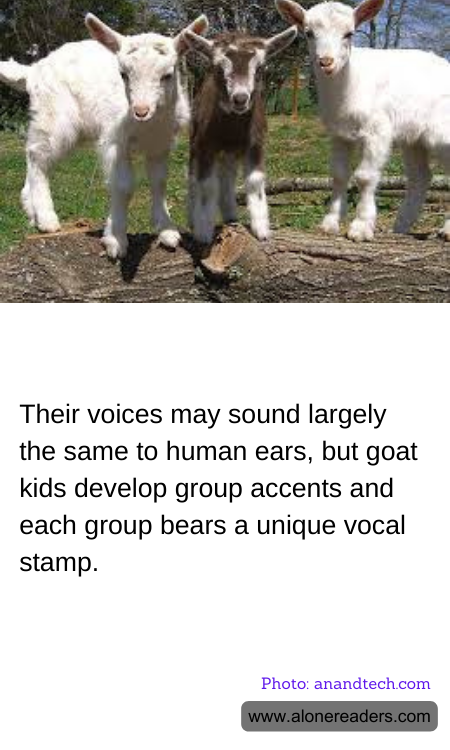
Goats, much like humans, exhibit a fascinating vocal characteristic: they develop distinct group accents. Research shows that goat kids adjust their calls to fit in with their peers, forming what can be likened to regional accents. This adaptation in vocalization is not solely based on genetic makeup or the inherent voice of the individual goat but is significantly influenced by their immediate social environment.
This phenomenon was observed in a study where researchers noticed that as young goats from different groups mixed, their individual vocalizations began to change and align more closely with those of their new group mates. This suggests that goats have a level of vocal plasticity which allows them to modulate their calls in response to their social surroundings – a trait previously thought to be predominantly seen in birds and mammals such as bats and elephants.
The ability of goats to change their vocal characteristics to conform with those of their group might be a social survival strategy, similar to how humans subconsciously alter their accents when they move to a different region. For goats, fitting in vocally might mean better integration or acceptance into a group, which is crucial for their social and physical survival. This vocal mimicry can foster cohesion within the group, creating a unified group identity that distinguishes them from other groups.
Understanding these vocal adaptations in goats not only sheds light on the social behaviors of this particular species but also enhances our broader understanding of animal communications. It challenges the notion that complex communication systems are exclusive to humans and a few other species, suggesting instead that the animal kingdom might be much more linguistically intricate than previously thought. This research paves the way for further studies into how and why animals develop group-specific communication systems and how these systems affect their social interactions and structures. The insights gained could potentially have wider implications, including strategies for better livestock management and new perspectives on animal welfare.
