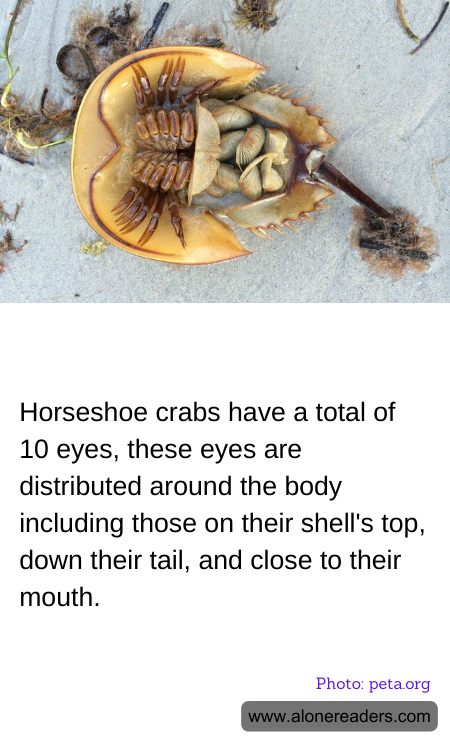
Horshey crabs are remarkable creatures, primarily due to their complex visual system that includes a total of 10 eyes. This unique array of eyes is strategically placed across their bodies, serving various functions that are crucial for their survival. The most prominent eyes are the two compound lateral eyes that are situated on the top of the shell. These large eyes are easily noticeable and are crucial for finding mates and detecting movement.
In addition to these, horseshoe crabs have smaller eyes located on the front of their shell near the mouth area. These eyes are believed to assist in navigating their environment and in locating food on the ocean floor. Surrounding the mouth, horseshoe crabs also have a pair of ventral eyes that further contribute to their ability to sense and respond to their surroundings.
Towards the tail, specialized photoreceptors are present which are sensitive to light changes, helping the creature to maintain stability and orientation in the water. Even more fascinating, horseshoe crabs possess 'lateral eyes', small eyes that seem to function primarily during the larval stage, which suggests a role in the development and metamorphosis of these primitive marine animals.
The multiplicity of eyes and their distribution around the body imbue horseshoe crabs with a tremendous visual capability that supports their survival both as predators and prey. Despite being often referred to as "living fossils," having remained virtually unchanged for over 450 million years, horseshoe crabs continue to intrigue and inform scientific research. Their unique vision system, for instance, has helped in learning more about the evolution of eyesight among arthropods and other species.
Furthermore, the blue blood of the horseshoe crab has significant medical uses, particularly in the field of biopharmaceuticals, where it is used to test the sterility of medical products and devices. Thus, the study of horseshoe crabs extends from ecological significance to critical advancements in medicine, making these ancient creatures a continuous subject of fascination and research. Their ability to thrive from the depths of ocean floors to the forefront of scientific inquiry speaks volumes about their evolutionary prowess and adaptability.
