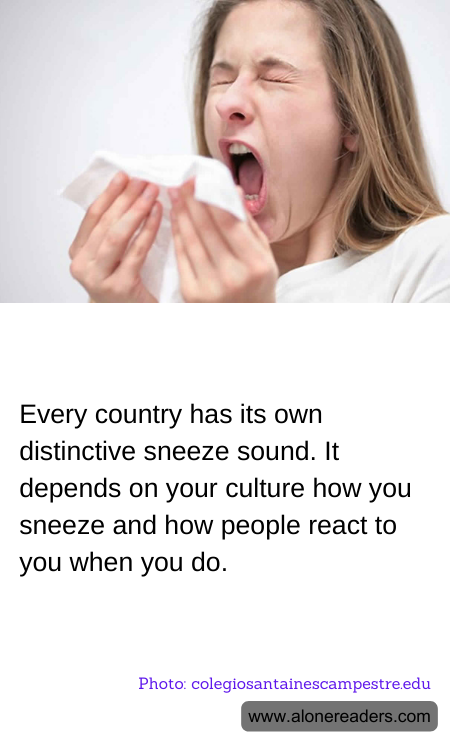
Sneezing, a universal human phenomenon, varies intriguingly around the world not just in how it sounds but in how it is perceived and responded to across different cultures. While the biological function of a sneeze is the same worldwide—expelling irritants from the respiratory system—the accompanying sounds and social reactions are shaped by linguistic, cultural, and social factors.
For instance, in English-speaking countries, the common onomatopoeic words describing sneeze sounds are "achoo" or "atchoo." This sound is so culturally ingrained that it's often used in literature and media when a character sneezes. In contrast, in Japan, the sound is often represented as "hakashun," and in the Philippines, it's notated as "ha-ching." These variations in phonetic transcription reflect the differing auditory interpretation of the sneeze sound in various languages and can influence how sneezes are perceived and responded to by those around us.
Beyond the sounds of sneezing, cultural attitudes toward sneezing vary significantly. In many Western cultures, it's customary to say "bless you" or "gesundheit" (wishing good health in German) after someone sneezes. This practice can be traced back to several historical beliefs, including one from the time of a plague where sneezing was thought to be a premonitory sign of illness, hence the blessing was a form of protection or a wish for good health.
Conversely, in some parts of Asia, there is often little to no verbal response to sneezing. It's seen more as a natural bodily function that doesn't necessitate a comment. In these cultures, drawing attention to someone's sneeze is sometimes considered impolite or unnecessary. However, personal discretion plays a role, and responses can vary between individuals and settings.
Moreover, the public health perspective on sneezing has added another layer to cultural interpretations, especially in the context of global events like the COVID-19 pandemic. The act of sneezing in public has become more stigmatized, and there is greater emphasis on etiquette such as sneezing into one's elbow or a tissue to prevent the spread of viruses.
In conclusion, while everyone sneezes, the way it sounds and the reactions it prompts can differ widely. These variations are not just trivial peculiarities but are deeply embedded in linguistic and cultural contexts. They reflect how something as involuntary and natural as a sneeze can be integrated into social norms and practices, illustrating the interesting ways in which human biology and culture intersect.
