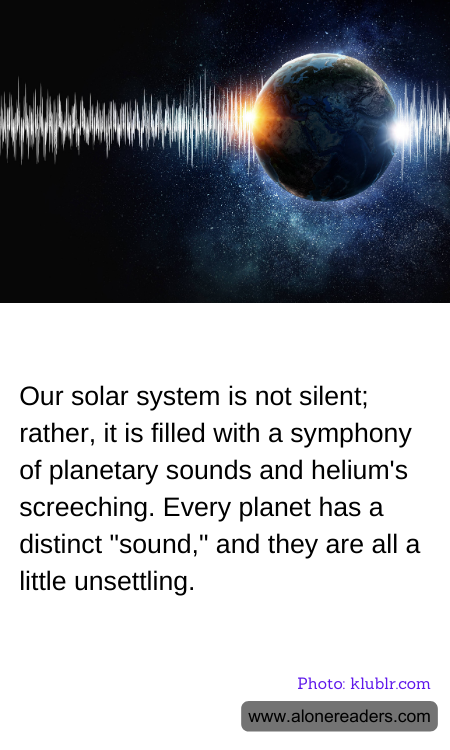
Contrary to the silent void that many imagine, space within our solar system is teeming with an array of enigmatic sounds. Despite the vacuum of space preventing sound from traveling as it does on Earth, spacecraft equipped with special instruments are capable of capturing electromagnetic vibrations and converting these into audio files that the human ear can interpret. Each planet, in its unique essence, contributes to an eerie cosmic concert that resonates across the solar system.
Jupiter, for example, hums with a deep, haunting roar. NASA's Juno spacecraft revealed this during its mission, capturing audio files that suggest a mingling of high energy particles within Jupiter’s magnetic field. This giant planet produces sounds so intense they resonate like the ominous beats of a distant drum, echoing the profound and massive presence of Jupiter itself.
Saturn offers another spectral piece in this planetary orchestra. The Cassini spacecraft recorded the eerie tones of Saturn’s ionosphere, collecting sounds that mimic an ethereal and melancholic whistling. The ghostly vibes result from particles within Saturn's magnetic field, a phenomenon similar to radio emissions picked up here on Earth.
Mercury's sounds are markedly different, characterized by sudden, high-pitched blips. These quick, screeching bursts resonate from the planet’s thin exosphere as it interacts with solar winds. The effect can be jarring, contrasting with the deep, ominous soundscapes of its larger counterparts.
Even our own Moon holds an acoustic signature, though it is stark and somewhat desolate. The Apollo missions picked up a distinctive "Moon music" during their expeditions, which astronauts described as otherworldly. These peculiar whistles and whines, likely electromagnetic phenomena, gave a voice to our silent satellite.
Today, researchers and astronomers continue to explore these sounds, looking to understand the complex interactions between solar winds, electromagnetic fields, and planetary atmospheres. As intimidating as these sounds can be, they offer us insights into the dynamic processes occurring within our celestial neighborhood. By decoding these cosmic voices, scientists hope not only to uncover more about the planets’ compositions and atmospheres but also to gain broader knowledge about the origins and mechanics of the universe itself. In doing so, they remind us that space, rather than a silent void, is filled with a vast and mysterious symphony.
