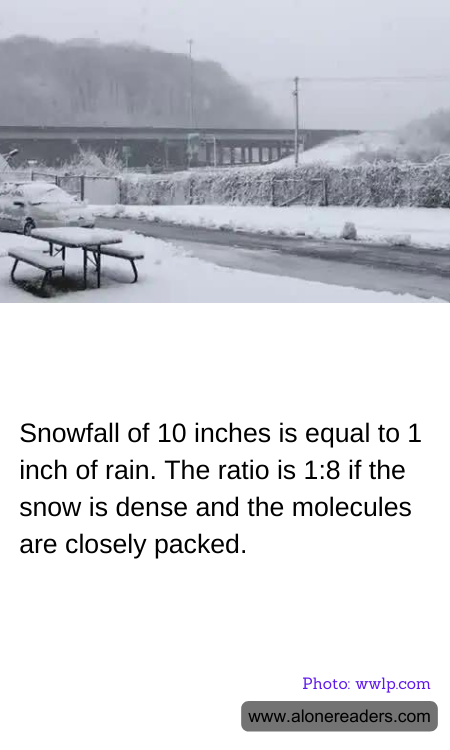
When trying to understand the water content of snow, it's important to remember that the common saying "10 inches of snow equals 1 inch of rain" is a rough average and can vary depending on the type of snow. This fact, while broadly useful, needs further elaboration based on the density and temperature of the snow, which can significantly alter this ratio.
Snowfall density can vary due to several factors, including air temperature and moisture content at the time the snow forms. Light, fluffy snow tends to occur when the temperature is colder, which means the air holds less moisture. Consequently, it takes more of this kind of snow to equal the water content of 1 inch of rain—sometimes even as much as 15 or 20 inches. On the other hand, wet, heavy snow typically forms under conditions closer to the freezing point, about 32°F (0°C). This snow contains more water, reducing the snow-to-rain ratio. Thus, it might only take 5 inches of wet snow to equal 1 inch of rain.
The quoted ratio of 10:1, as an average, works well for general weather forecasting and quick calculations. However, during certain cold spells where the snow is very dry and powdery, this ratio can increase dramatically, indicating less water per volume of snow. Contrastingly, when snow is dense and the flakes are closely packed—often described as "wet snow"—the ratio could indeed be closer to 1:8, as stated. This dense snow is more typical in coastal areas with higher temperatures during winter storms, or when the tail end of a storm transitions into warmer weather.
Predicting and understanding these ratios is crucial not only for daily weather forecasts but also for managing water resources in regions dependent on snowmelt for their water supply. Ski resorts, agricultural operations, and municipalities managing snow removal operations also benefit from understanding these variations in snow density.
Given the variability in the water content of snow, methods for accurate measurement include manual sampling and analysis of snow density, as well as technological approaches such as remote sensing using radar. These practices help meteorologists and hydrologists to provide more accurate forecasts and maintain effective water management practices, ensuring that communities are better prepared for the impacts of both snowfalls and resultant water supplies as the season progresses.
