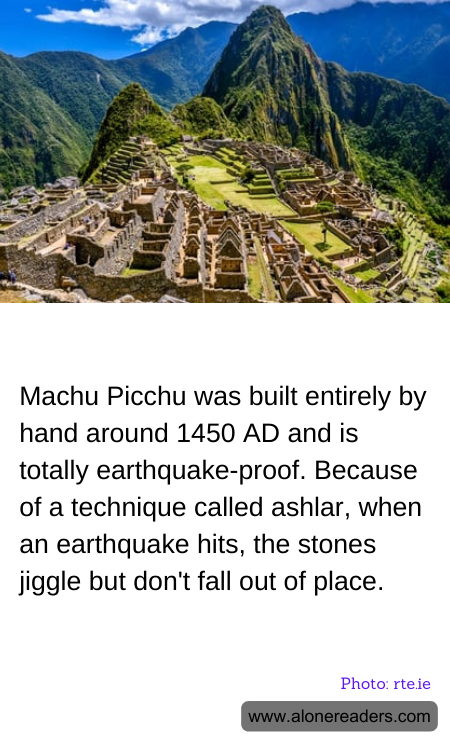
Machu Picchu, often referred to as the "Lost City of the Incas," is a marvel of ancient engineering and architecture perched high in the Andes Mountains of Peru. Built around 1450 AD during the reign of Inca emperor Pachacuti, this breathtaking site was constructed completely by hand, without the aid of wheels or iron tools. Despite its seemingly precarious location, Machu Picchu has withstood the test of time, notably surviving numerous earthquakes that have struck the region over the centuries.
One of the key reasons for Machu Picchu's resilience is the traditional Inca construction technique known as ashlar masonry. This method involves cutting stones so precisely that they fit together tightly without the need for mortar. The precision of this technique is so remarkable that not even a knife blade can fit between two stones. This interlocking system not only provided stability but also flexibility, allowing the structures to absorb and withstand the seismic forces unleashed during earthquakes.
The stones used in constructing Machu Puncho can jiggle and move slightly during an earthquake but typically fall right back into place, maintaining the integrity of the structure. This earthquake-proofing characteristic is attributed to the slightly tapered shape -- broader at the bottom and narrower at the top -- and the rounded corners of each stone, which help distribute the seismic forces throughout the structure.
Ironically, while these ancient builders mastered the art of earthquake-resistant construction, it is only in recent decades that modern science and engineering have begun to unravel and appreciate the sophistication of their techniques. Today, Machu Picchu not only stands as a testament to the advanced skills of the Incas in architecture and engineering but also serves as an important research site for scientists and engineers looking to enhance contemporary building practices in seismic zones.
In addition to its structural brilliance, the strategic choice of location — situated on a high ridge surrounded by lush, steep mountains and divided by a deep canyon — helped protect Machu Picchu from discovery by the Spanish conquistadors. It wasn't until 1911 that the explorer Hiram Bingham brought the site to international attention. Since then, Machu Picchu has become an iconic symbol of Incan heritage and a major tourist attraction, drawing visitors from around the globe eager to witness its historic sanctity and architectural genius.
