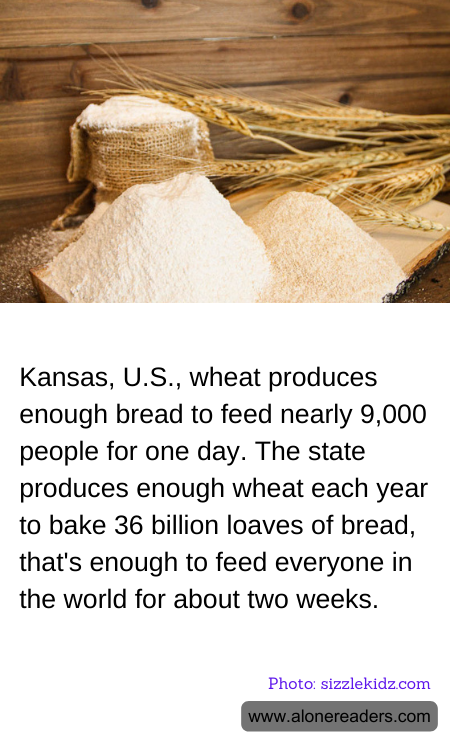
Kansas, often hailed as the "Breadbasket of the World," holds a pivotal role in global wheat production, particularly in its contribution to bread making. The state’s agricultural prowess can be particularly appreciated through some staggering statistics: within one day, the wheat harvested from Kansas has the potential to produce enough bread to feed nearly 9,000 people. This figure becomes even more impressive when extrapolated over the course of a year.
Annually, Kansas yields enough wheat to manufacture approximately 36 billion loaves of bread. To put this in perspective, if these loaves were distributed evenly across the globe, Kansas alone could feasibly supply every person on Earth with bread for about two weeks. Such productivity underscores not only the fertility of Kansas's farmlands but also the efficiency and modern advancements in agricultural practices prevalent within the state.
These achievements in agriculture are not just remarkable in terms of volume but are also crucial for food security. Wheat is a staple food in many diets around the world and is vital for nutrition due to its high contents of carbohydrates and proteins, along with essential nutrients like B vitamins. Kansas’s massive contribution to the world’s wheat supply plays a significant role in stabilizing global food markets and ultimately supporting nutritional needs in various populations.
Indeed, the success of wheat production in Kansas is supported by both the natural conditions and the technological advancements in agriculture. The state's geographical location in the U.S. Great Plains offers optimal growing conditions for hard winter wheat, which thrives in the cold winters and warm summers. Moreover, the adoption of modern farming technologies such as precision agriculture has enabled Kansas farmers to increase their yields while managing resources more efficiently, thereby reducing waste and environmental impact.
This impressive scale of production comes with responsibilities as well. It highlights the importance of sustainable farming practices to prevent soil degradation and ensure that this breadbasket can continue to supply large amounts of wheat in the face of challenges such as climate change. It also poses logistical and economic questions about how best to distribute this vital resource, mitigate market fluctuations, and support farming communities.
Ultimately, the story of wheat production in Kansas is a powerful testament to the significance of agriculture in global economic systems and in supporting life around the planet. As Kansas continues to supply a substantial portion of the world’s wheat, it exemplifies both the challenges and the vital nature of sustainable agriculture in our modern world.
