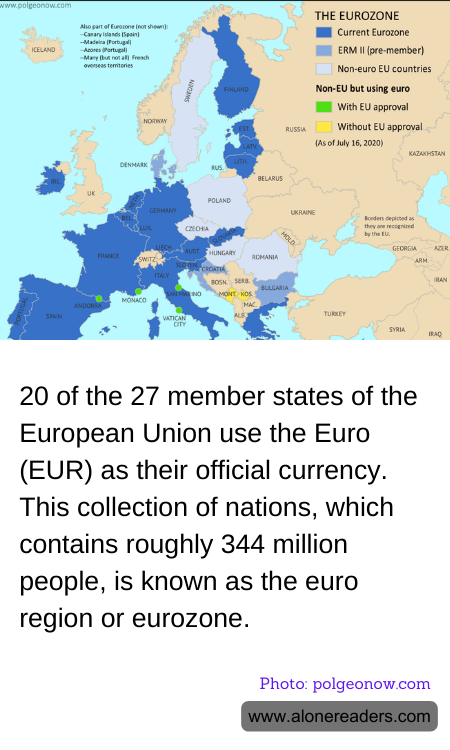
The eurozone represents a significant achievement in economic integration and cooperation among European nations. With 20 of the 27 European Union member countries adopting the euro as their official currency, approximately 344 million people have been brought together under a single monetary framework. This integration facilitates easier trade, travel, and economic stability across these nations, significantly impacting both micro and macroeconomic elements across borders.
The decision to adopt a common currency, introduced in 1999, was driven by the vision of fostering greater economic integration and strengthening the internal market. For businesses and consumers, the common currency has simplified cross-border transactions, eliminating the need for currency exchanges and reducing transaction costs. This, in turn, has contributed to more competitive markets and potentially lower prices for consumers.
Moreover, this monetary union, overseen by the European Central Bank (ECB), aims to maintain price stability, which is crucial for economic growth. By formulating monetary policy centrally, the ECB has a significant role in influencing economic conditions throughout the euro area. The uniformity in monetary policy helps to protect the eurozone from asymmetric shocks through mechanisms like inflation targeting and adjusting key interest rates.
However, the eurozone is not without its challenges. Economic disparities among member states have led to debates about the flexibility and effectiveness of a one-size-fits-all monetary policy. For example, economically stronger countries like Germany might have different economic needs compared to those facing economic struggles such as Greece or Italy. Such disparities have necessitated complex fiscal coordination and bailout measures to ensure stability and solidarity within the eurozone.
To address these and other challenges, eurozone nations work collaboratriely towards creating stronger economic structures, including banking unions and capital markets unions, which aim to further stabilize and integrate the region’s economies. As the eurozone continues to develop and adapt, its success or struggle serves as a keenly observed model of monetary union worldwide. The benefits of such a union are evident, but so are the complexities it must navigate to ensure equitable economic growth and stability across its diverse member states.
