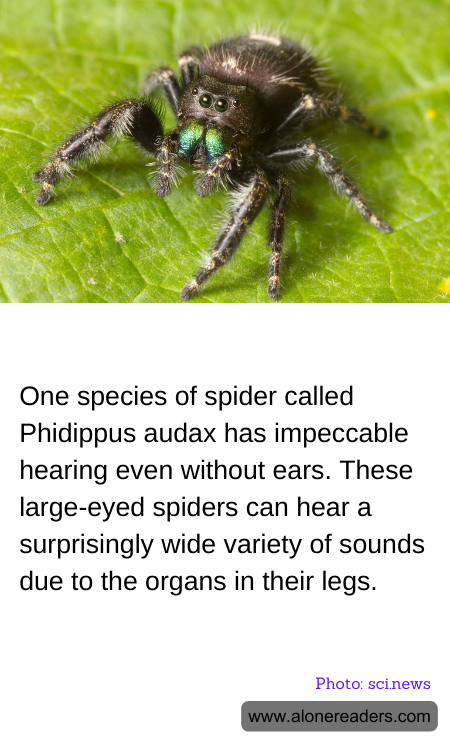
Phidippus audax, commonly known as the daring jumping spider, displays a remarkable auditory ability, despite lacking conventional ears. Known for their distinctive large eyes and sharp visual acuity, these spiders have also mastered the art of hearing through an unconventional method—using their legs. Intriguing research reveals that the tiny sensory hairs and receptors located on the legs of Phidippus audax can pick up vibrations and sounds from their surrounding environment.
This capability is not just limited to close-range detection; these spiders can sense noises from several meters away. Such auditory sensitivity plays a crucial role in their survival, aiding in the detection of predators and prey alike. The sounds of flying insects, for example, can alert the spiders to potential meals, while the low-frequency vibrations of approaching larger animals warn them of possible threats.
The mechanism behind this fascinating form of hearing involves the fine hairs on the spider's legs that respond to airborne vibrations. These vibrations are transmitted through the body and interpreted by the spider's nervous system. Scientists believe that this form of hearing is not just a rudimentary sense but a sophisticated adaptation that allows Phidippus audax to navigate its environment more effectively.
Understanding how Phidippus audax and similar species utilize these capabilities may provide insights into the evolution of sensory perception among arachnids. It also opens up intriguing possibilities for biomimetic applications in technology, particularly in the development of new types of sensors that mimic this natural prowess. Thus, the study of such unique creatures continues to contribute valuable knowledge to both the scientific community and technological innovation.
