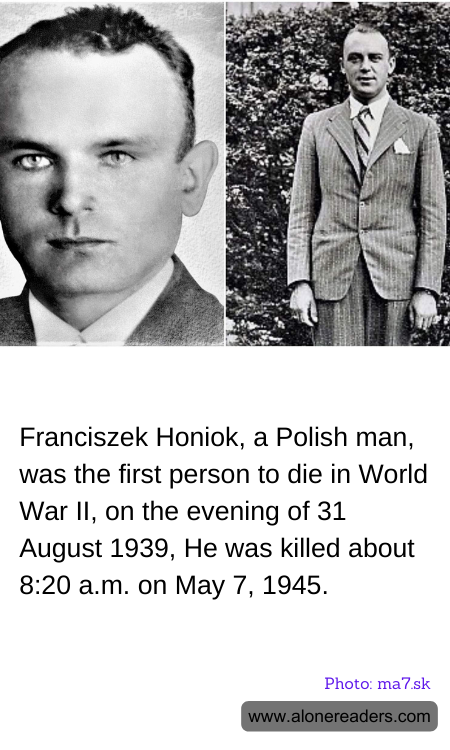
Franciszek Honiok, a Polish civilian, holds a grim distinction in the annals of history as the first person to die in World War II. On the evening of August 31, 1939, Honiok was killed, marking the onset of a conflict that would engulf the world for the next six years. His death was not a result of battlefield engagement; rather, it was a premeditated act that was part of a larger strategy orchestrated by Nazi Germany.
The circumstances surrounding Honiok’s death are tied to an operation known as the Gleiwitz incident, which was one of several covert actions conducted by the Nazis to create the appearance of Polish aggression against Germany. This false-flag operation aimed to provide Adolf Hitler with the pretext to invade Poland, which he did on September 1, 1939, thus starting World War II. Franciszek Honiok, who was an ethnic Pole, was selected by the Gestapo because he was known for his pro-Polish sympathies, making him a suitable victim for their fabricated narrative of Polish hostility.
On the night of his death, Honiok was dressed in a Polish military uniform by the SS, who then murdered him and left his body at the scene of the Gleiwitz radio station, which they had attacked. This staged assault on the radio station was broadcast to Germany and was used to claim that Polish saboteurs had attacked German soil, thereby justifying Hitler’s order for the invasion of Poland.
The deceitful nature of Honiok’s death symbolizes the sinister tactics deployed in the political and military strategies at the time, reflecting the dark beginnings of the deadliest conflict in human history. His death did not just signal the start of World War II; it also exemplified the ruthless manipulation of truth by authoritarian regimes to achieve their geopolitical goals. It remains a poignant reminder of the individual tragedies that are often overshadowed by the broader narratives of war.
