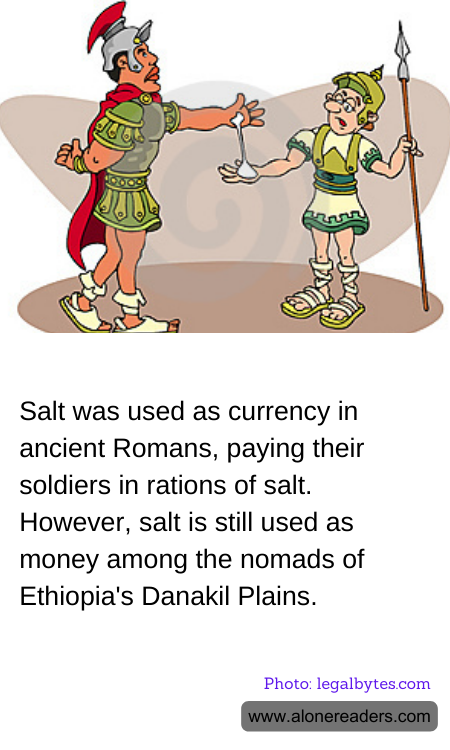
Salt, a basic mineral familiar and essential in daily sustenance, has played a surprising role as a form of currency throughout history. One of the most fascinating examples of this can be traced back to ancient Rome, where salt was not merely esteemed for its ability to preserve and season food but was also integral to the Roman economy as a means of payment. In a period where coinage was still not fully standardized across the vast territories of the Roman Empire, soldiers were often paid with salt rations—a practice that hints at the origins of the word "salary," derived from "salarium," which relates to salt. This form of payment not only underscores the value of salt but also reflects how essential commodities could serve as effective currency in place of traditional money.
Fast forward to the modern-day, and surprisingly, the tradition of salt as currency persists in some parts of the world, such as among the nomads of Ethiopia's Danakil Plains. The Danakil Plains, characterized by their harsh and inhospitable environment, are one of the hottest places on earth with temperatures that can soar above 50 degrees Celsius. Here, salt is still mined traditionally from the ground using age-old techniques passed down through generations. For the nomadic tribes of this area, salt bars, known locally as 'amoleh', serve not only as a staple for dietary needs but also as a unit of trade and currency. These salt bars are used to trade for other goods like livestock and vegetables, playing a pivotal role in the local economy.
The continued use of salt as money among the Danakil nomads is a testament to the enduring value of this mineral and presents a stark contrast to the globalized financial systems dominated by digitized money transactions. It highlights how traditional economies adapt to their specific environmental contexts and how ancient practices can sustain modern communities. Moreover, it offers a unique perspective on the concept of money, emphasizing that monetary value is not intrinsic to the items used as currency but is rather assigned by the needs and contexts of a society. This enduring legacy of salt, from ancient Rome to the plains of Ethiopia, provides not just a historical account but also a deeper understanding of the socio-economic frameworks that have shaped human civilization.
