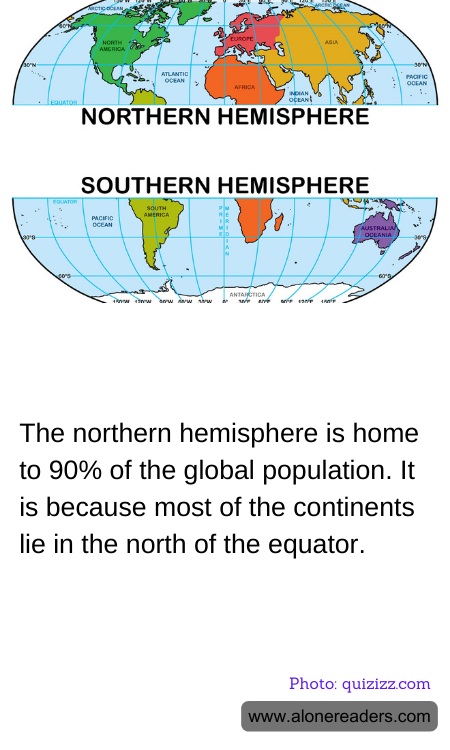
The northern hemisphere hosts a staggering 90% of the world's population despite comprising roughly the same amount of land as the southern hemisphere. This demographic phenomenon primarily stems from the geographical distribution of land masses. Most of the Earth’s land, including the entire continental masses of Europe and North America and the vast majority of Asia, is located north of the Equator.
This northern concentration of continents explains the skewed population distribution. Vast, habitable land areas with favorable climates, fertile soil, and abundant resources have historically attracted and supported large human populations. In contrast, the southern hemisphere is predominantly water, with the continents of South America, Australia, and a small portion of Africa straddling the Equator and extending southward. Antarctica, also located in the southern hemisphere, remains sparsely populated due to its extreme climate.
Historical development also plays a critical role in population distribution. Human civilization has an extended history in the northern hemisphere with ancient civilizations in Mesopotamia, Egypt, and the Indus Valley driving initial population growth. Over centuries, as these civilizations expanded and new ones emerged in Europe and Asia, population growth accelerated, supported by advances in agriculture, industry, and technology.
Moreover, the majority of economic powerhouses and developed nations, such as the United States, China, and countries in Western Europe, are situated in the northern hemisphere. The concentration of economic activities, better healthcare, education systems, and higher living standards attract migrations from less developed nations, further increasing the population density in the north.
Despite possessing only about 10% of the world's population, the southern hemisphere plays a crucial role in global biodiversity and contains significant natural resources. Countries like Brazil and Australia contribute substantially to the world’s oxygen supply, biodiversity, and mineral and agricultural resources. The contrast in population density also impacts environmental stress, with the northern hemisphere experiencing more significant impacts from urbanization and industrialization.
In summary, geographic, historical, and socio-economic factors combine to make the northern hemisphere the more populous part of the world. Understanding this distribution is crucial for addressing global challenges related to urban planning, resource management, and sustainable development.
