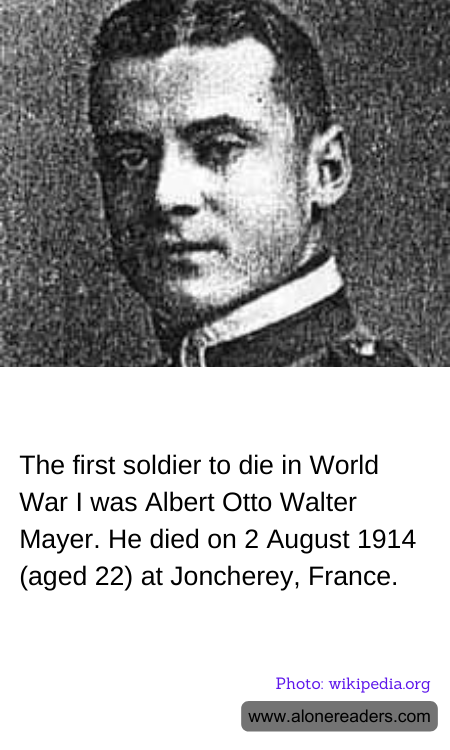
The first soldier killed in World War I was Albert Otto Walter Mayer, a German cavalryman whose death marked the beginning of one of the most devastating conflicts in modern history. Born in 1892, Mayer was a part of the German army’s advance into France at the very outset of the war. His demise on August 2, 1914, near Joncherey, France, occurred just one day after Germany declared war on Russia, setting off a chain reaction among aligned nations.
Mayer was part of a small patrol sent into French territory to gauge enemy movements and positions. During this mission, Mayer and his comrades encountered French troops. In the skirmish that ensued, Mayer was shot by French Corporal Jules-André Peugeot in what is considered one of the first combat engagements of the war. Ironically, Corporal Peugeot also fell in this exchange, becoming one of the first French casualties of the war. This tragic encounter underscored the immediacy and ferocity of the war that would engulf much of the world over the next four years.
The deaths of Mayer and Peugeot symbolize the grim reality of a war that was initially expected to be quick and decisive but instead prolonged into a grueling four-year struggle, claiming millions of lives. They remind us of the individual human stories that are often lost in the vast numbers and statistics of war casualties. Mayer’s death, just like that of many others in the war, highlights the tragic waste of life and potential caused by political conflicts played out on the battlefields across nations.
