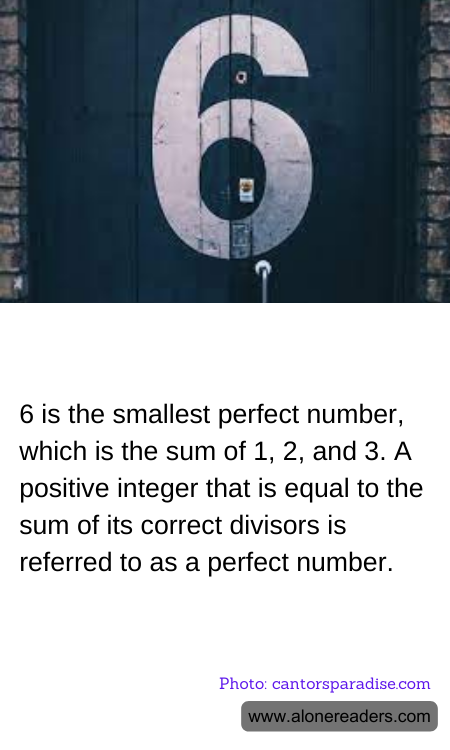
Perfect numbers have fascinated mathematicians for centuries, particularly because of their unusual and harmonious characteristics. The concept of perfect numbers is ancient, with its roots stretching back to the era of Pythagoras who, along with his followers, held the belief that numbers represented the underpinnings of the universe and could explain its harmony. The smallest and perhaps most well-known perfect number is 6, which is distinctive because it is exactly equal to the sum of its divisors (excluding itself), namely 1, 2, and 3.
This attribute is central to the definition of a perfect number: it is a positive integer that equals the sum of its proper divisors. Following 6, the next perfect number is 28, further comprising 496 and 8128 – these numbers are rare but hold special significance in number theory due to their unique properties. The sequence of perfect numbers unfolds slowly, aligning with their scarcity and the mathematical challenge of identifying subsequent perfect numbers.
Euclid first shed light on perfect numbers mathematically in his work "Elements," where he proved that if \(2^p-1\) is a prime number (now known as a Mersenne prime), then \(2^{p-1}(2^p-1)\) is a perfect number. Centuries later, Euler extended this theorem, showing that all even perfect numbers must take this form, making it a central theorem in the study of such numbers. However, the mystery deepens with odd perfect numbers, which to this day have not been found, leading mathematicians to wonder if they exist at all.
The study of perfect numbers thus not only delves into the fundamentals of number theory but also touches aspects of computational mathematics, as the search for larger perfect numbers and Mersenne primes involves massive amounts of computational power and sophisticated algorithms. This interplay between theoretical mathematics and practical computation exemplifies the depth and complexity that seemingly simple concepts like perfect numbers can exhibit.
The curiosity surrounding perfect numbers serves as a poignant reminder of the beauty and mysteries inherent in the mathematical landscape, inviting enthusiasts, professional mathematicists, and computational experts alike to explore and unravel the secrets they hold. As tools and methodologies evolve, the pursuit of understanding perfect numbers continues to be a significant and inspiring challenge within the broader context of mathematical inquiry.
