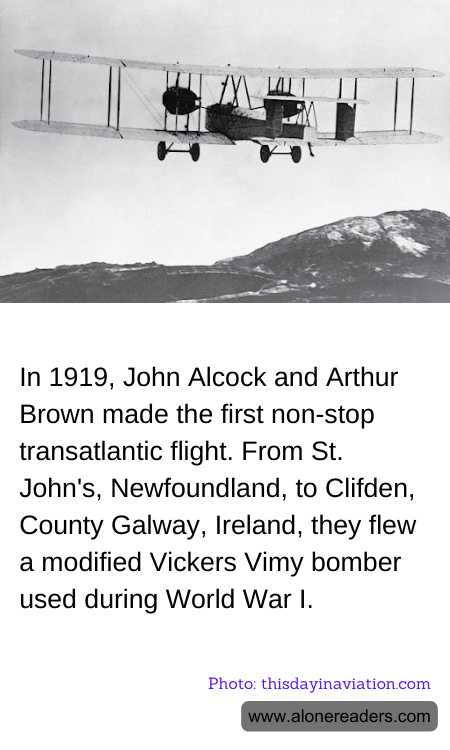
In 1919, a pivotal moment in aviation history was marked by John Alcock and Arthur Brown as they completed the first non-stop transatlactic flight, fundamentally altering the future of international air travel. Their journey began in St. John's, Newfoundland and concluded in a bog near Clifden, in County Galway, Ireland. This landmark flight took place on June 14-15, spanning approximately 1,890 miles (3,040 kilometers) across the challenging environment of the North Atlantic.
Flying a modified Vickers Vimy bomber, originally designed for warfare during World War I, Alcock and Brown embarked on their daring expedition. The aircraft was adapted for the long flight by outfitting it with extra fuel tanks in the fuselage and converting a bomb bay into a space for additional provisions and navigation instruments. The adventurous duo faced numerous challenges including thick fog, snowstorms, and ice formation on the aircraft, which occasionally forced Brown to climb out on the wings mid-flight to remove ice from the engine air intakes.
Their flight lasted just under 16 hours, navigating mostly by dead reckoning, which was no small feat given the limited navigational technology of the time. Upon encountering severe weather, Brown's skills as a navigator proved invaluable as he adeptly used a sextant to guide them towards their destination. In the end, their Vickers Vimy crash-landed in the Derrygimlagh Bog near Clifden, but fortunately, both pilots emerged unscathed and were celebrated as heroes.
Their achievement not only tested the possibilities of long-distance aviation but also symbolized the beginning of a new era in global connectivity. For their accomplishments, Alcock and Brown were knighted by King George V shortly after their flight. The success of their perilous journey demonstrated the potential of aerial travel and laid the groundwork for the development of international air routes, substantially decreasing travel times around the world and making air travel more accessible. This historic flight remains a significant milestone in the history of aviation, illustrating the power of human ingenuity and bravery in overcoming the bounds of possibility.
