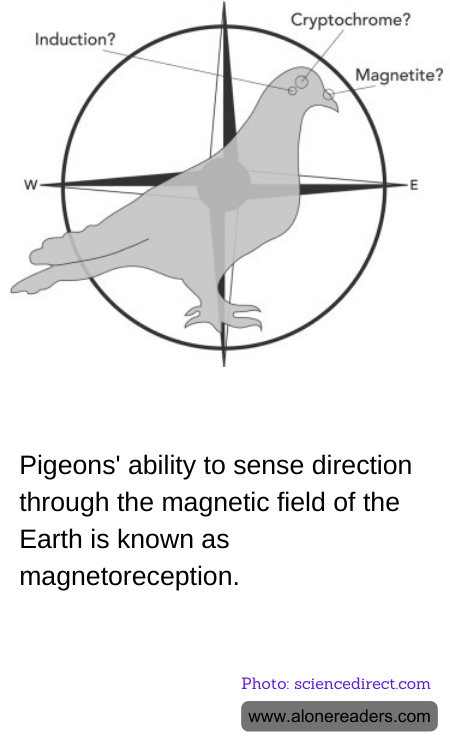
Pigeons have long fascinated researchers and bird enthusiasts not only for their ubiquitous presence in urban landscapes around the world but also for their remarkable ability to find their way home, even over long distances. One of the key navigational tools pigeons possess is known as magnetoreception, an ability that allows them to sense Earth's magnetic field, thereby helping them to determine their direction.
The notion that pigeons can detect Earth's magnetic field was first proposed after observing their homing behavior, which remains accurate across varied and unfamiliar terrain. Research has shown that pigeons, like several other species, have magnetoreceptors, which are biological sensors linked to their nervous system, specifically believed to be located in their beaks. These receptors detect changes in the magnetic field, allowing the birds to orient themselves and navigate effectively.
Scientific studies suggest that these magnetic sensors react differently depending on the strength and angle of the Earth's magnetic field, giving pigeons a biogeographical map. This capability is complemented by the bird's ability to use other navigational cues such as the sun position, stars, and landmarks, which pigeons are also remarkably adept at identifying.
However, how pigeons precisely integrate this magnetic information with other sensory information for navigation remains a subject of ongoing research. It's hypothesized that the brain's hippocampus, an area known to be pivotal in spatial memory and navigation in mammals, plays a crucial role in processing the different types of navigational inputs in pigeons.
In addition to providing insights into avian migration and navigation, studying pigeons' magnetoreception offers broader implications for understanding the evolutionary biology of other species, including potentially humans, and the development of new navigation technologies. It is intriguing to consider the ancient mariners and their tales of birds guiding them through fog and across open waters, which may have been observations of magnetoreception in action.
Moreover, unraveling the mystery of pigeon magnetoreception enhances understanding of the impacts of electromagnetic pollution, a growing concern in our increasingly digital and urbanized world. Such pollution can disrupt the magnetic orientation, not only of pigeons but also of other wildlife species relying on Earth's magnetic field for navigation.
Thus, pigeonerception not only demystifies a piece of the complex navigation puzzle of these birds but also underscores the interconnectedness of life forms and Earth's natural systems. In studying these remarkable abilities, humans may learn not only about animal behavior but also about how to coexist more harmoniously with other species within the shared environment.
