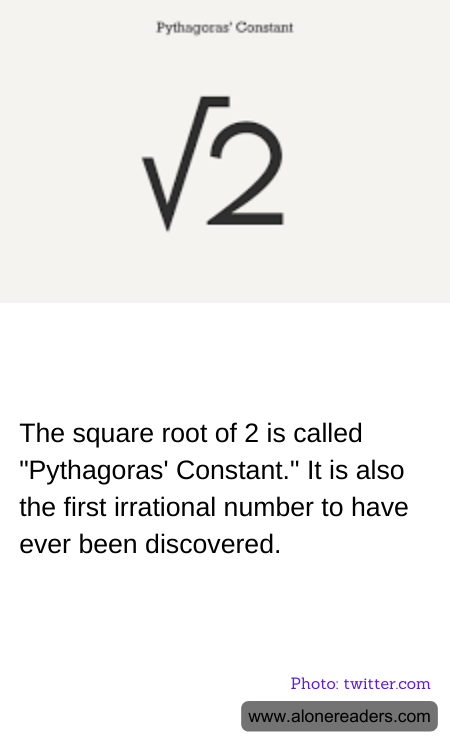
The square root of 2, often referred to as Pythagoras’ Constant, holds a significant place in the annals of mathematics. This number, approximately equal to 1.41421, is legendary not only for its mathematical properties but also for its historical importance as the first known irrational number. The ancient Greeks stumbled upon this irrationality while exploring the properties of geometric figures, specifically the square. The diagonal of a square with side length one was found to be the square root of 2, a realization that challenged the existing notions of numbers and magnitude that were prevalent during that era.
The story of the square root of 2 is intricately linked with the name of Pythagoras, the ancient Greek mathematician and philosopher known for his eponymous theorem relating to the sides of a right triangle. Although Pythagoras himself might not have been the first to discover the irrationality of the square root of 2, his school of followers, the Pythagoreans, famously grappled with its implications. The discovery was particularly unsettling because it contradicted their firm belief in the ability of whole numbers and their ratios to express all numeric quantities. The realization that the diagonal of a square and its side could not be expressed in terms of a ratio of whole numbers shook the foundations of their understanding of the numerical universe.
The proof of the irrationality of the square root of 2 is one of the earliest examples of a mathematical proof and remains a staple in mathematical education today. It typically involves a proof by contradiction, starting with the assumption that the square root of 2 is a rational number (expressible as a fraction of two integers) and demonstrating that this assumption leads to a logical contradiction, thereby proving that the number must be irrational.
The implications of the irrationality of the square pushed mathematicians to explore other irrational numbers, opening up a broader understanding of number systems. Moreover, this exploration laid pivotal groundwork for the development of algebra and the eventual broad acceptance of irrational, real, and later, complex numbers in mathematics. The square root of 2 itself continues to appear in various fields, not just in geometry or algebra but in modern disciplines such as physics, engineering, and computer science, serving fundamental roles in designing structures, solving equations, and programming algorithms.
Thus, the square root of 2 is more than just a mathematical curiosity; it represents a profound shift in mathematical thinking and a stepping stone towards modern mathematical theory and application. Its discovery is a testament to the evolving nature of mathematical understanding and its continuing capacity to challenge and expand the horizons of human knowledge.
