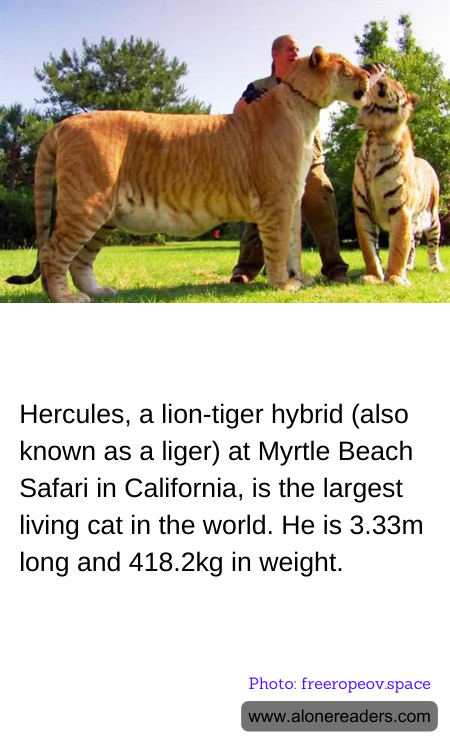
Hercules, the remarkable liger residing at Myrtle Beach Safari in California, holds the title of the world's largest living cat. This majestic hybrid, born from the union of a male lion and a female tiger, embodies the defining characteristics of both species, presenting a unique blend that has captivated animal enthusiasts worldwide. Standing as a testament to the awe-inspiring possibilities of crossbreeding, Hercules measures an impressive 3.33 meters in length and tips the scales at 418.2 kg.
Ligers, such as Hercules, are typically larger than both of their parent species due to a phenomenon known as hybrid vigor, which results in increased growth. Unlike tigers and lions that have established habitats and recognizable behaviors, ligers are not found in the wild; their existence is solely within the confines of captivity, where special care and management are provided. Hercules, in particular, enjoys a diet specifically tailored to meet his extraordinary nutritional needs and engages in enrichment activities that promote his physical health and mental wellbeing.
The existence of Hercules highlights not only the marvels of genetic inheritance but also raises awareness about the ethical implications of breeding hybrid animals. While Hercules is healthy and thrives under the watchful care of his handlers at Myrtle Beach Safari, the practice of breeding hybrid animals like ligers is met with a mixture of fascination and concern among conservationists and animal ethics experts. Issues such as health problems, shorter life spans, and lack of true habitat call into question the viability of such crosses beyond human amusement or scientific curiosity.
The story of Hercules, while unique and filled with grandeur, serves as a pivotal point for discussions about conservation priorities, ethical animal treatment, and the future of wildlife both in captivity and in the wild. His existence encourages a dialogue about the responsibilities humans hold towards these magnificent creatures and the natural world at large. As we marvel at Hercules’ size and strength, it's crucial to consider the broader implications of his life as a liger, prompting ongoing debate about the role of hybrid animals in modern conservation efforts.
