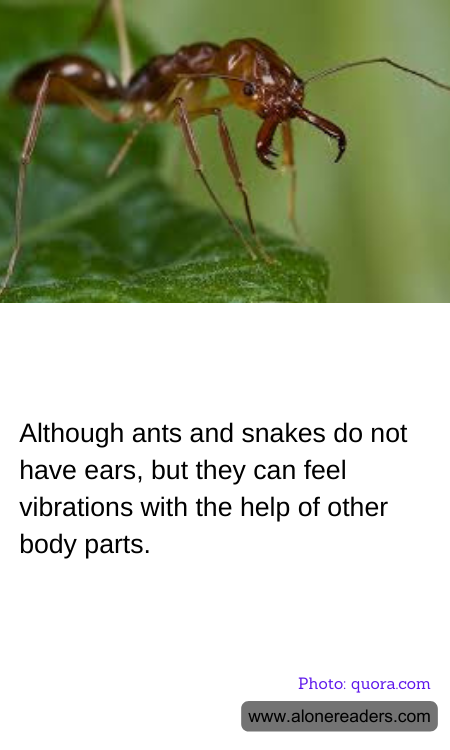
Despite lacking conventional ears, both ants and snakes have evolved unique mechanisms to detect and respond to their environment, particularly through vibrations. Ants, with their complex social structures and behaviors, perceive vibrations through their legs. Equipped with extremely sensitive receptors, these insects can feel even the slightest tremor in the ground. This sensitivity to vibrations is crucial for communication among colony members and also aids in detecting predators or other threats.
On the other hand, snakes, which are often mistakenly thought to be deaf, have a different approach to perceiving sounds. Instead of relying on external ear structures, they use their jawbones to detect vibrations. When a sound wave hits the ground, it produces vibrations, which the snake can sense through its jaw as it rests on the earth. This ability is linked to the evolutionary development of their skeletal and muscular systems, which allows the vibrations to be transmitted to the cochlea, an organ in the inner ear analogous to that in humans, bypassing the need for external ears.
These capabilities highlight a fascinating aspect of evolutionary biology, showing how different species can adapt to their environments in unique ways. Ants and snakes have successfully occupied ecological niches where acute vibrational perception is more critical than auditory signals that other animals with traditional ear structures use. This vibrational sense not only helps in basic survival by alerting them to danger but also plays a critical role in hunting prey and communication.
Understanding these mechanisms offers insight into the diversity of sensory systems in the animal kingdom and exemplifies how life forms adapt physically and behaviorally to their specific ecological contexts.
