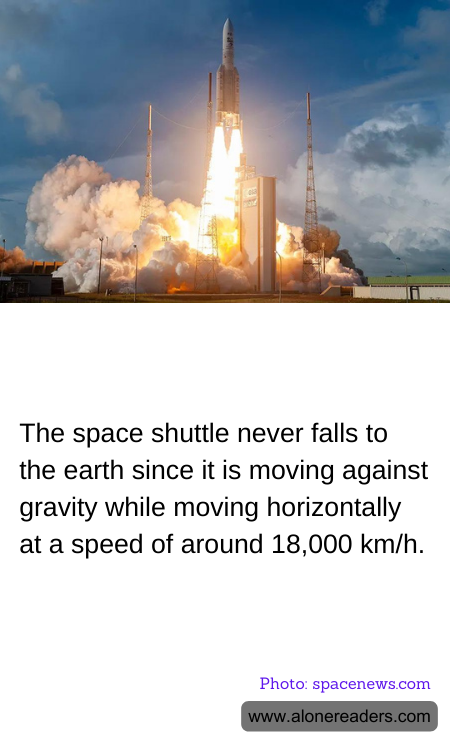
The intriguing aspect of space shuttles and their ability to remain in orbit without falling back to Earth lies in their remarkable speed and the principles of physics that govern orbital mechanics. Contrary to what might be intuitive, space shuttles, and other satellites, do not escape Earth's gravity entirely. Instead, they are in a constant state of freefall towards the Earth. However, they never actually hit the Earth’s surface because they are moving horizontally at an incredibly high speed.
When a space shuttle is launched, it initially ascends directly into the space to exit the Earth’s atmosphere. After reaching a certain altitude, it then begins to increase its horizontal speed. It is this speed, approximately 28,000 kilometers per hour (around 17,500 miles per hour), that is crucial. At these high speeds, the shuttle's forward motion is enough to counteract the pull of gravity trying to draw it back down to Earth. Essentially, the Earth's surface curves away at the same rate that the shuttle falls; therefore, the shuttle keeps falling around the Earth, continuously missing it, which is what being in orbit means.
This delicate balance of velocity and gravitational pull is what keeps satellites and space stations in continuous orbit. It’s a concept that was first understood by Sir Isaac Newton who described a thought experiment involving a cannonball fired from a mountain top. If the cannonball were fired with sufficient speed, it would orbit around the Earth rather than falling back down to the ground. Modern space travel applies this principle through careful calculations and engineering feats, enabling shuttles to maintain their orbit for extended periods.
Moreover, it's not just about reaching the speed but maintaining it along with the altitude that ensures the satellite or space shuttle remains in stable orbit. Perturbations like atmospheric drag (for low Earth orbits), gravitational pull from celestial bodies, and solar radiation pressure can affect the orbit, requiring occasional adjustments, typically done through maneuvers called "orbital station-keeping."
This exploration of orbital dynamics not only underpins the functionalities of countless satellites in various applications ranging from communications to weather forecasting and global positioning but also underlines the precision required in space missions, illustrating once again the remarkable human capacity to harness basic physical laws for groundbreaking ventures into space.
