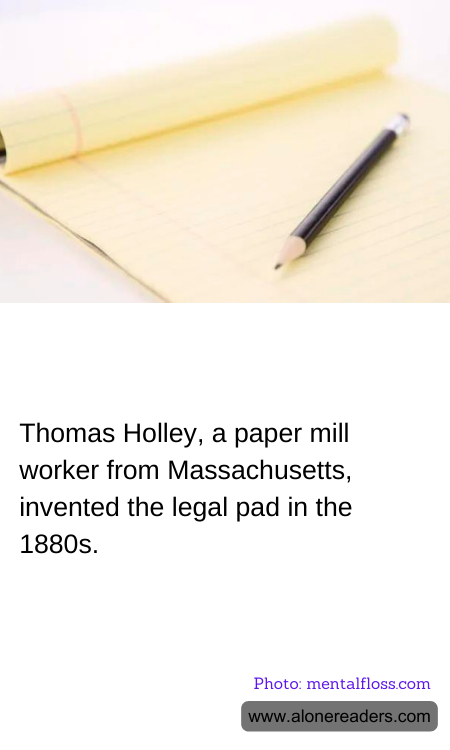
The legal pad, a staple in law offices and business environments alike, has an intriguing origin story that dates back to the 1880s. The invention is credited to Thomas Holley, a humble paper mill worker in Holyoke, Massachusetts. Holley's innovation was born not out of a deliberate attempt to create a new product, but rather from his observation of potential waste at the mill where he worked.
At the time, paper mills often discarded the leftover paper that was trimmed off during the production of large sheets. Holley saw an opportunity in these scraps, which were still perfectly usable. He collected these remnants and had the idea to stitch them together into small, convenient pads. This not only helped reduce waste but also provided a low-cost alternative to full-sized sheets of paper.
The distinctive feature of the legal pad, the wide margin at the top, known as the "down lines," was not part of Holley's original design. This aspect was added later as the pads gained popularity among legal professionals, who appreciated the extra space for notes and comments while reviewing documents. This modification turned what started as a simple recycled product into an iconic tool tailored specifically for the legal community.
Holley’s innovation did more than just create a new product; it reflected an early instance of recycling and sustainability in manufacturing. His clever use of materials not only saved resources but also provided a practical solution for note-taking and record-keeping that would become a lasting part of business culture.
Today, legal pads are universally recognized by their yellow color, although they were initially available in various shades depending on the type of scrap paper used. The yellow color became standard due to its mild hue, which reduces eye strain. The legal pad's journey from a mill worker’s simple idea to an essential office product highlights the impact of inventive thinking and resourcefulness, making Thomas Holley’s contribution a notable example in the history of everyday objects.
