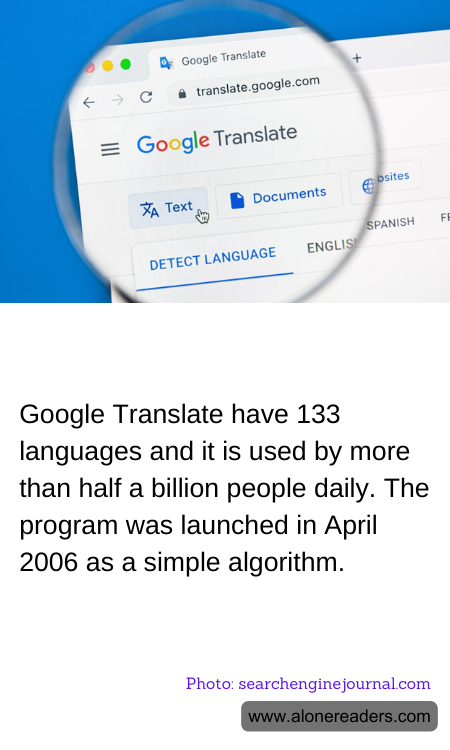
Google Translate, a revolutionary tool in the realm of digital communication, has remarkably transformed the way we understand and interact with the world's diversity of languages. Launched in April 2006, it began as a rudimentary algorithm but has since evolved into a comprehensive and indispensable tool for over half a billion users each day. Initially supporting just a few languages, Google Translate now boasts a staggering repertoire of 133 languages, enabling a vast array of interpersonal and professional communications globally.
The impact of Google Translate stretches far beyond mere word-to-word conversion. Its development over the years has incorporated advanced technologies such as machine learning and artificial intelligence, which have significantly enhanced its accuracy and usability. This has not only democratized language translation for personal use, such as for travelers and students, but it has also become a crucial asset for businesses engaging in international trade, offering them the ability to communicate across linguistic barriers with unprecedented ease.
Moreover, Google Translate has played a pivotal role in promoting inclusivity and understanding among diverse cultures. By breaking down language barriers, it fostails a greater exchange of ideas and fosters mutual respect among different communities. Its features like website translation, real-time conversation mode, and integration with apps and services underline its versatility and responsiveness to the growing demands of global communication.
Despite its vast capabilities, Google Translate continues to face challenges and criticisms, particularly in areas of contextual and nuanced language translation. While it excels in providing a general understanding, the subtleties of languages sometimes elude its algorithms. However, ongoing improvements and updates are progressively minimizing these gaps, enhancing its reliability.
As we look toward the future, the trajectory of Google Translate suggests an even more integrated approach in overcoming language barriers. With advancements in AI and machine learning, alongside growing internet accessibility, Google Translate is set to further innovate and possibly offer more personalized and context-aware translation solutions. This will not only expand its utility but also its significance as a tool for global connectivity and understanding, propelling us into a future where language differences do not hinder human interaction but enrich it.
